


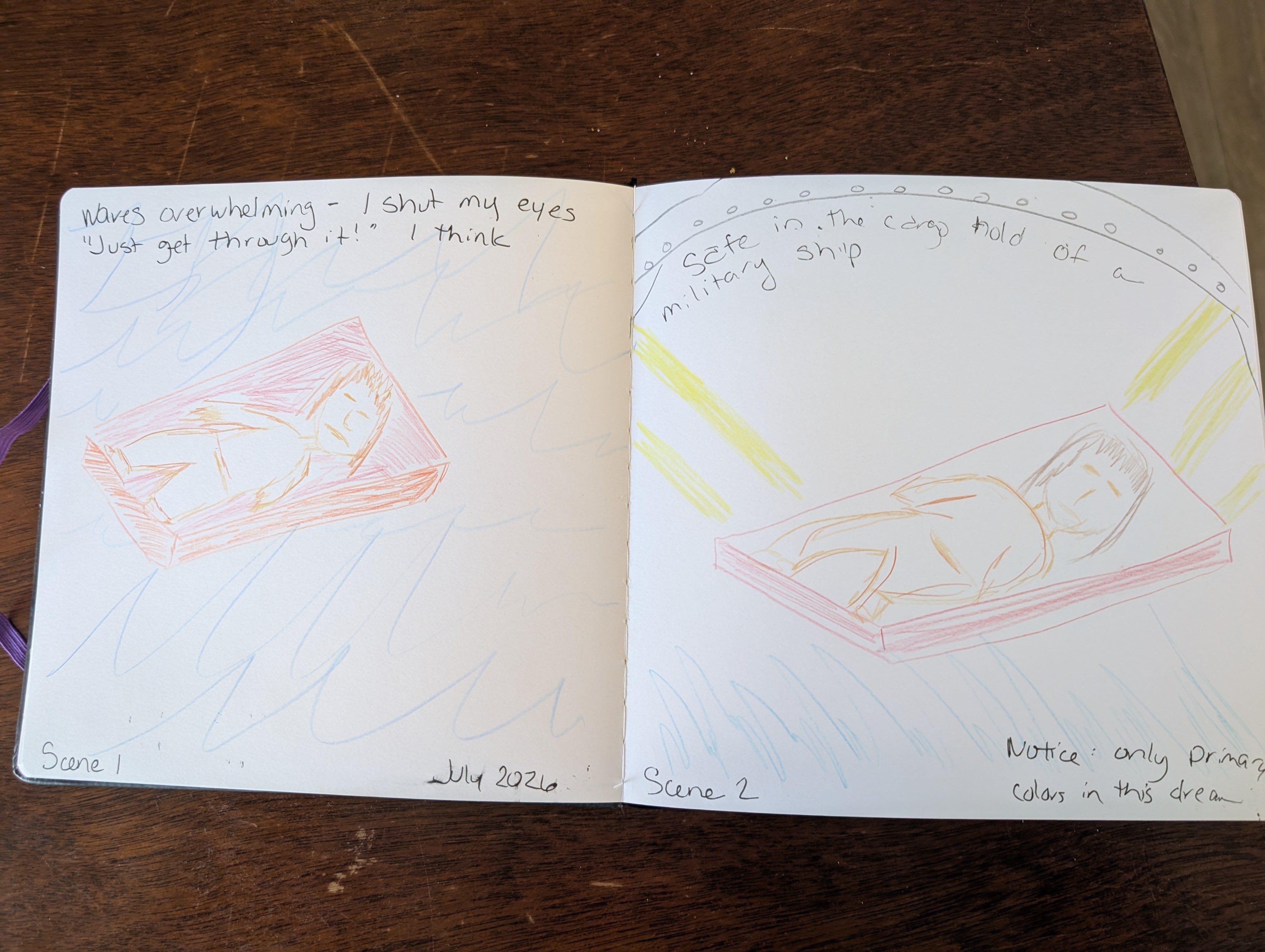
This week, we are wrapping up a series on the dreaming life and how God utilizes your dreams to help you understand your soul’s needs. We have covered everything from why the Bible uses dreams to how the early church viewed them, what sort of journaling you should keep, and why interpreting dreams should be the last step.
When we undertake the subject of Christian dreaming, we understand that we are stepping into a tradition that is at least 5000 years old and that the early church in the first couple of hundred years after Christ wrote and taught a lot about the discernment practices that were used, as well as understanding the types of dreams that came. In our paid subscriber series, we covered this topic in great detail so that you can start hearing from God as a devotional practice.
AI versus Dreams
I don’t want to get too philosophical, but we are in an age where many people are extremely wary of the AI advances. My BA was in Emerging Media, and my MA’s are both in Jungian Depth Psychology, so I am positioned to understand why and where humans exist in this technological hierarchy. Additionally, both my husband and I rely upon technology due to our disabilities and health issues (I have Cerebral Palsy, he has type 1 diabetes), and this interdependence on technology with our human biology will only increase over the years. So, I am writing from a space today that looks at AI both critically as a Depth Psychologist and with a great deal of hope, as someone with a degree in Emerging Media.
What we all need to understand is that AI can already outsmart us in the Bible, various methodologies, theories of exegesis, historical and archaeological findings, and many other areas. Because we have been excellent “Bereians” (those who studied the word of God in Berea, Greece, when Paul was traveling through), the internet is filled with amazing articles that help AI build its understanding.
However, AI cannot dream.
Now, perhaps one day dreaming will be part of an AI feature, but what I’m trying to help you understand is that dreaming is a highly personalized language between you and God: AI will never touch that aspect of our soul. We are dreamers because we are created in the image of God, and some things, like our intelligence, can be co-opted by AI, but our dreams cannot. Our dreams are a very special part of our created nature.
When we engage with the dreaming life, we engage with the soul’s attempt to commune with God, or remember its way back to pre-fall Eden. Dreams open a doorway to the next transformative step your soul needs to understand its purpose: to be a son or daughter of God (Romans 8). Dreams enhance our ability to become that son or daughter.
Dreaming as Art
When I first started tracking my dreams 25 years ago, I was very detailed and dreamt prolifically. It was odd if I wasn’t up several times a night writing down dreams in painstaking detail, like a plot of a movie. And those of you who have read this entire dream article series know that that is no longer how I suggest you do it. First, because a practice like that isn’t sustainable, mainly because its rooted in fear. There’s a fear that if I miss one dream, its message, or the importance, I’m missing what God wants me to know. Let’s not strengthen that type of fear-rooted perfectionism.
What I’ve done up until about a year ago, though has been to track the:
· Emotional tones
· Major symbolic moments
· Big action of the dream
· And usually only after coffee
Now, writing your dreams right after you wake up is a good idea if you can do it without it becoming a “have-to” ritual. For me, when I first wake up (before coffee), I tend to analyze a dream away, and it’s not until I’ve had my coffee that I am in the headspace to honor the message. But you do you.
Then, last year, everything changed.
I was studying Carl Jung’s mandalas and the Lord spoke to me. He told me it was time to start illustrating my dreams, instead of writing them down as a journal entry. I’m going to be honest, I wasn’t thrilled at the suggestion. I do create art often, but I’m rarely in the headspace to do it, except maybe 1-2 times a year. You yourself might know of several objections to God with a suggestion like that, too. You might think:
· I can only draw stick figures badly.
· I don’t have the time
· I can barely journal my dreams, let alone illustrate them
· I’m not artistic
And I’m not discounting any of those objections. But I am going to challenge you.
Why Art is Pivotal to Your Dream Journal
Remember what I said in weeks 1 and 2 of this dreaming article arc: God uses symbols to convey information. God uses a universal language of symbols both in the Bible, in parables, and in our dreams. This is a way that he conveys information, for a reason. Symbols aren’t fixed; they transform. They mean different things to different people, which is exactly why he uses them. God uses symbols to help you build a personal relationship with Jesus, one that is strengthened by NOT UNDERSTANDING your dream life!
So when God asked me to illustrate my dreams, not write them down, I struggled. What I didn’t realize was that I was already “translating” the dream from symbols into English when I “wrote down” my dreams. And translation always loses some essence of meaning, which is why most theologians have to train in Greek and Hebrew to assess the Bible.
By returning to the same “language” of my dream when recreating the symbols, I’m actually taking the time to think about the dream in its original form. I’m thinking things like:
· Does that color truly represent the image in my dreams?
· Why are there so many upward spatial planes in my dreams recently?
· Does this symbol (a mirror) look like this other thing (a spoon), and can that help me understand its meaning?
As you can see, these types of questions come up in illustrated dream journals in a way that would never come up in a written one, mainly because we are staying within the same vehicle of language: symbols!
Carl Jung was an Artist
Jung was the first one that I know of in modern day to keep an illustrated dream journal. In fact, I read one review of his artwork, and the reviewer said that Jung would have become famous for his art if he had allowed the art world of the day to receive him as an artist rather than as a psychologist. Jung worked with watercolors, oils, calligraphy, stonework, and architecture. He never saw himself as an artist; he saw himself as someone who needed art to understand his soul.
Jung began doing this when he realized his rational brain tended to extract only intellectual meaning, not the meaning of the soul. Just think about that for a moment. How often are we reinforcing our intellect, rather than our soul? Using art is one way for us to pull out of an AI-dominated space and into the true place of being human. It started one day when Jung was at Bollingen, a tower he built on Lake Zurich, and he decided to build a castle from the materials on the ground, just as he had as a child. Totally immersed in his project, he began to connect the dots and make meaning in places he did not expect. In fact, play became an integral part of Jung’s work, and anyone who needs to disconnect from the rational world in order to understand what God is speaking to their soul.
Using the Last 9 Weeks
Words will flatten the depth of your dream life; illustrating them will invigorate it. However, I’d rather you journal them SOMEHOW rather than not at all. Additionally, if you feel like you are the kind of person who just can’t make art, consider other ways of being artistic: here is a picture of one of our students who re-created the castle of her heart using AI. No art skills were needed, but she was still able to have dimensions of understanding open up in ways she hadn’t expected.

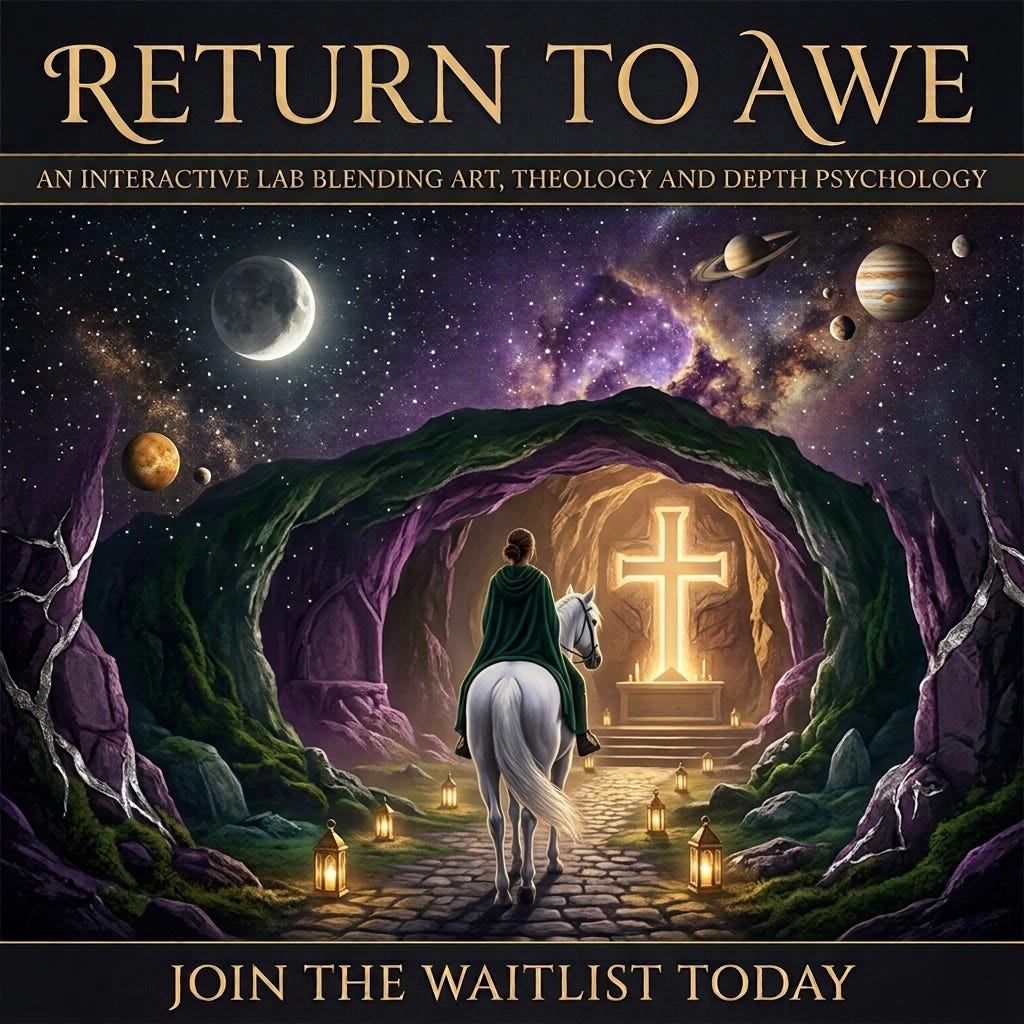
If you feel as though you are really leaning into this material and want to know more, I want to invite you to “Return to Awe” an e-course happening this fall blending art, theology and depth psychology. We eill go into these practices together and learn the art of dreaming in a way that will really strengthen what you’ve learned over the last 10 weeks.
A Return to Awe — This Fall
* Blends art, theology, and depth psychology into one practice, so you finally have a framework for the dream life you’ve been having alone for years.
* Built for the Christian who has the doctrine down and still feels like something’s missing on Sunday night.
* Go deeper into God’s love than a sermon can take you. This is an encounter, not an explanation.
* Real-time, personal feedback from Angela on your own dreams. Not a symbol dictionary. A direct response to what God is actually showing you.
* An interactive lab, not a lecture series. You’ll turn a dream’s central image into art, journaling prompts, nature walks, and more.
* Guided group contemplation in the same ways that the early church fathers did it.
Spots are limited because this is about community, not the masses.
Early-bird wait list gets first access when doors open, before the general public even hears about it. Join by clicking here.
.