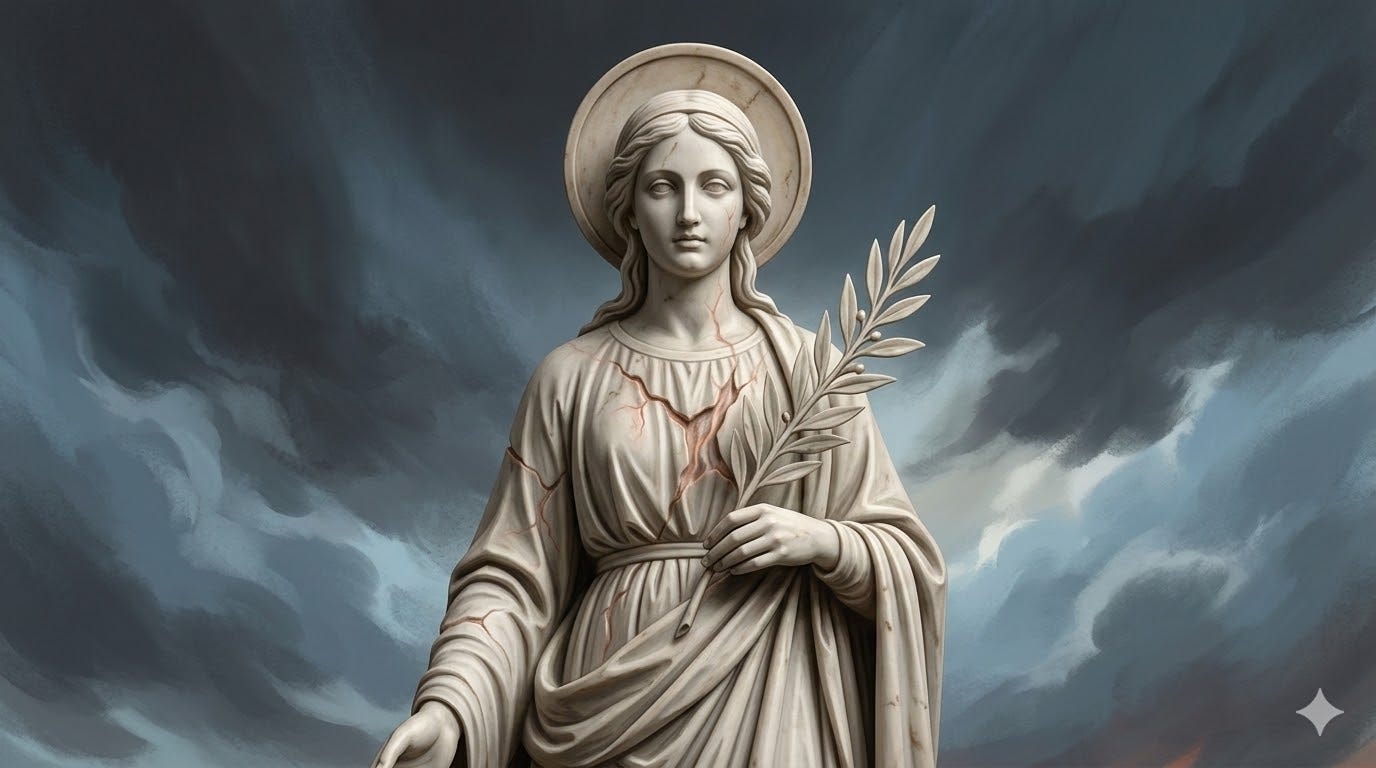


One of the quiet myths many Christians absorb is the belief that holiness should look polished. We learn, often without realizing it, that the faithful life appears orderly, respectable, and well, “nice.” The testimony is tidy, the emotions are hidden beneath varnished exteriors, and the believer appears spiritually composed from the outside. We’ve all heard about, or even experienced, the “church elder” who beat his kids at home and drained his wife of any personality, and while these are extreme truths, we all deal with a church persona, that doesn’t match the reality of our inside. And if we are not challenged on this, over time we begin to believe that looking sanctified is nearly the same thing as being transformed.
But the longer I walk with Christ—and the deeper I study the human soul—the more convinced I become that the carefully constructed Christian persona may actually be one of the greatest obstacles to genuine spiritual life. There is a profound difference between being good and being real, and the Church rarely knows the difference. Goodness can be rehearsed and displayed, but authenticity must be formed slowly by the Spirit in the hidden places of the soul.
This distinction matters because the abundant life Jesus promises in John 10:10 is not given to the polished version of ourselves we present to the world. It is given to the real person God created beneath the layers of adaptation, fear, and social expectation. And very often the journey toward that real self begins with a surprising and uncomfortable realization: the identity we spent years constructing may not actually be the life God intended us to live.
Where We Are in the Journey
In this space we have been slowly tracing what I call The Inner Exodus—the Spirit’s quiet but relentless work of leading believers out of spiritual stagnation and into a life that is actually animated by Christ. The Exodus in Scripture was not simply a physical departure from Egypt; it was a spiritual reorientation in which God’s people had to confront the systems, assumptions, and identities they had learned to survive within. In the same way, many Christians today sense that something in their faith feels dry, constrained, or strangely smaller than the abundant life Jesus promised.
So far in this unfolding conversation we have been exploring how the Spirit begins dismantling those structures and inviting us into a deeper spiritual reality.
We have looked at several movements within this journey:
• The drought of false Christianity — how the well of living water that exists in Jesus often fails to spring up into the abundant life He promised, and how believers begin recognizing that something essential has been missing. (Article entitled: The Prophet and the Psyche: When the Word Catches Fire)
• The undoing of the false self — the socially acceptable version of spirituality many of us unconsciously learn to perform, and why the Holy Spirit is not interested in improving that version of us but in replacing it altogether. (Article entitled: The Inner Exodus: Why the Holy Spirit Is Not Improving You — He Is Replacing the False Self)
• The return of the numinous — learning to recognize and welcome the mysterious work of the Spirit, and becoming reacquainted with a God who does not merely instruct but encounters and transforms the human soul. (Article entitled, “Reclaiming the Spirit: Carl Jung and the Return of the Numinous to Christianity)
Each of these themes reveals the gap between the outcome of Christianity that Jesus taught and the real lived reality many have faced: first recognizing the drought, then confronting the false self that formed within that environment, and finally rediscovering the living presence of the Spirit.
Today we turn to a particularly subtle and dangerous expression of that false self: the Persona, and the powerful archetype of the polished saint.
When “Good Christianity” Becomes a Mask
Carl Jung used the term Persona to describe the social identity every human being develops in order to function within a community. The Persona itself is not inherently deceptive; it is simply the role we learn to inhabit in different environments. Teachers teach, pastors lead, parents nurture, and each of those roles requires some degree of adaptation in order to function well within social life.
The problem arises when the role quietly replaces the person. When this happens the Persona stops being a social tool and begins becoming an identity prison. We start performing a version of ourselves that fits the expectations around us while deeper aspects of the soul remain unexplored or underdeveloped.
Christian communities unintentionally intensify this tension because the virtues we celebrate—obedience, humility, discipline, spiritual maturity—are all good things that can easily become part of a performance. Over time a believer may begin presenting a version of themselves that looks spiritually mature even while parts of their inner life remain hidden or unformed. Eventually the mask becomes so familiar that we forget we are wearing it.
The Hidden Cost of the Servant Who Buried His Future
The Parable of the Talents is usually interpreted as a lesson about productivity: use your gifts faithfully and do not waste what God has given you. But if we read the story carefully we notice that the servant who buried his talent was not simply lazy. He was afraid of risk, and rather than entering the uncertainty of growth he chose preservation instead.
Theologian Hans Urs von Balthasar captured the deeper tension of this story when he wrote, “What you are is God’s gift to you. What you become is your gift to God.” The servant preserved what he had received but refused the transformation that would have allowed it to grow into something new.
Many Christians quietly recognize themselves in this moment of the parable. At some point we sensed a creative impulse, an intellectual curiosity, a prophetic sensitivity, or a calling that did not quite fit the identity we had built within our community. Instead of risking disruption, we buried it.
Jung would say the human psyche is a landscape of seeds waiting to grow, and Scripture itself reflects this pattern repeatedly.
• Abraham leaves the stability of his homeland.
• Moses abandons the life he built in Midian.
• Joseph follows dreams that nearly destroy his family relationships.
The God of Scripture rarely preserves the identities people construct for themselves. Instead He invites them into lives they could never have predicted.
Einstein, Jung and the Work of the Spirit
The young Albert Einstein once experienced a waking vision of himself sledding through space beside a beam of light, and the image seized his imagination so powerfully that he began asking a strange question: What would the world look like if I could travel at the speed of light? That imaginative moment eventually led to the theory of relativity.
What fascinates me about this story is where the breakthrough began. It did not begin with mathematics but with symbolic imagination. Years later Einstein had dinner with Carl Jung in Zürich, and Jung began to see something similar happening in the inner life of the soul.
The psyche has its own form of relativity.
Your healing, your calling, and your transformation do not unfold according to the timetable of religious expectations. They unfold according to the mysterious rhythm through which the Spirit gradually forms a human life. Jung called this process individuation, while Christian theology might simply call it the slow sanctifying work of the Holy Spirit.
The Spirit does not move on the clock of social approval. Sometimes transformation unfolds slowly and invisibly, while at other times it disrupts the identities we thought were stable. But the Spirit is not interested in preserving the persona we constructed to survive our environment. The Spirit is interested in forming the true self created in Christ.
My Own Life as a Parable
I remember when my own faith moved from a familiar Evangelical environment into a Charismatic one. The transition did not simply change my theology; it changed the social world that had once shaped my spiritual life.
Relationships shifted. Community expectations changed. Some friendships quietly dissolved because the language of faith that once united us began to move in different directions.
At the time the experience felt disorienting, but looking back I recognize something deeper taking place. Individuation often strips away the cultural forms we inherited so that we can ask a more honest question: What part of my faith is genuinely mine, and what part was simply inherited performance?
Hebrews 12:29 reminds us that “our God is a consuming fire.” Fire does not merely destroy; it refines. It burns away what is false so that what is true can finally emerge.
The Deeper Question Beneath the Persona
At some point in this journey many believers recognize that something in their spiritual life feels constrained or artificial. For many believers the beginning of this journey feels less like enlightenment and more like loss. They sense that a role is being performed but struggle to identify what that role actually is. The deeper question is not whether we have a Persona—every human being does—but what identity we learned to inhabit in order to survive spiritually, socially, or emotionally.
This is where the work of spiritual formation becomes deeply personal. Recognizing the Persona requires courage because it means acknowledging that parts of our life may have been shaped more by fear or approval than by the quiet guidance of the Spirit.
If you are a paid subscriber, look for our Inner Room essay, where we will explore this question more directly. We will look at how the Christian Persona forms, why it often feels necessary for survival inside religious communities, and how the Holy Spirit slowly invites us to lay it down so the deeper self can emerge.
But before moving forward, it is worth pausing and allowing this realization to settle gently into the soul.
Pause • Pray • Heal
(Please note that a full version of the Pause • Pray • Heal videos are available for paying subscribers).
Pause - Sit with Him for a few moments. The Spirit often begins His work not through dramatic revelations but through gentle awareness.
Pray - You might pray the words of Thomas Merton:
My Lord God,
I have no idea where I am going.
I do not see the road ahead of me.
I cannot know for certain where it will end.
Nor do I really know myself,
and the fact that I think I am following your will
does not mean that I am actually doing so.
But I believe that the desire to please you
does in fact please you.
And I hope that I have that desire in all that I am doing.
I hope that I will never do anything apart from that desire.
And I know that if I do this you will lead me by the right road,
though I may know nothing about it. *
Heal - Take a moment today to sit quietly before God and consider this question:
Where in my life am I presenting a version of myself that feels spiritually acceptable rather than authentically real?
This question is not meant to produce shame. The Persona forms because it protects us from rejection, misunderstanding, or vulnerability. Recognizing it is not an act of judgment but an act of courage.
Consider Subscribing to go Deeper (Inner Room)
The paid subscriber article will continue this conversation by exploring:
· how the Christian Persona actually forms and
· why it can be so difficult to recognize in ourselves.
· We will also look at practical ways the Spirit begins loosening the grip of that identity so that the deeper self in Christ can emerge.
* “The Merton Prayer” from Thoughts in Solitude by Thomas Merton. Copyright © 1956, 1958 by The Abbey of Our Lady of Gethsemani.