

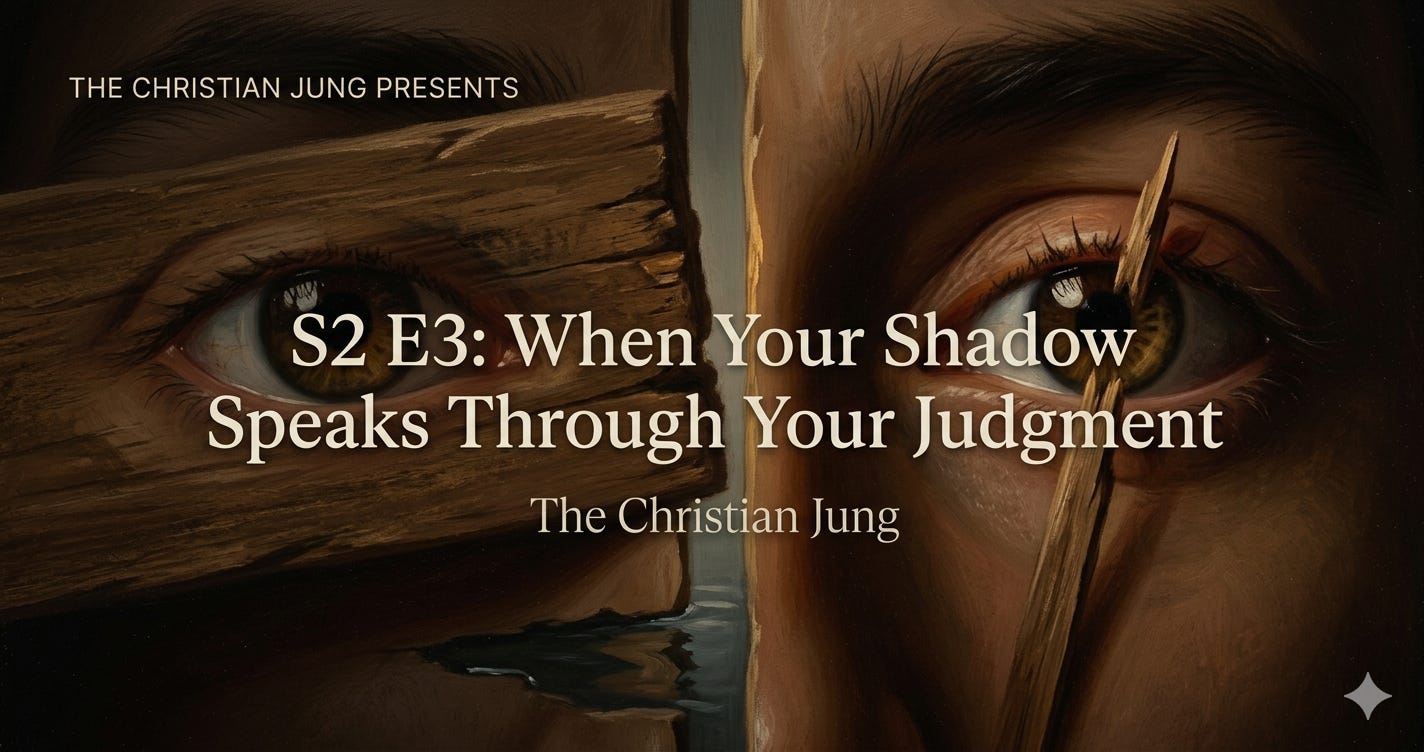
The person you cannot stop judging is the most accurate map to your own buried self that you currently have. That sentence may be the most useful one I write all year, and I want to start there because most of us are walking around with a precision instrument we have been taught to read backwards.
You know the people I mean. The ones whose particular flavor of brokenness inflames you. The kind of Christian whose theology you find suffocating, the kind of woman whose ambition makes you wince, the kind of man whose certainty makes you contemptuous. The acquaintance you cannot pray for honestly because every time you try, your mind goes immediately to what they should change. The political enemy whose every statement reveals some defect that you can name without effort. The relative whose patterns you have catalogued so completely that you could write the case study yourself. You know exactly who I am asking you to think about. And what I am about to tell you is that these people, the ones you most reliably condemn, are not coincidental occupants of your moral attention. They are the parts of you that you have most thoroughly disowned, dressed up in someone else’s clothes, walking around in front of you, asking to come home.
I know this sounds offensive at first. You are a serious Christian. You have spent your life trying to develop discernment, and discernment requires the ability to name what is wrong. The capacity to call sin sin is part of the gift of moral seriousness. I am not asking you to lay that down. I am asking you to consider that the intensity of your moral reaction, the charge in your body when certain people come into your awareness, is doing a different kind of work than your discernment is doing. Discernment is calm. Projection is loud. And we have spent two thousand years confusing the two.
Where We Are in the Inner Exodus
The Inner Exodus is the slow, week-by-week unrolling of a systematic theology of psychological wholeness. We are working under one core conviction: the psyche is the soul, and the soul is what Christ wants abundant life to flow through. Discipleship is not only behavioral. It is psychological, spiritual, and embodied. Through Scripture, contemplative Christianity, and depth psychology, we are recovering the inner terrain where transformation actually begins.
Last week we named what the shadow is. The self that learned to hide. The parts you buried because the environment of your first formation made it costly to bring them into the light. We named how the church in particular can become the site of shadow formation, because the church speaks with theological authority and what gets buried under that weight goes deeper than what gets buried under family weight alone. We ended with a question rather than an answer: what if your most faithful spiritual disciplines have been aimed at the surface rather than the shadow?
This week we move from diagnosis to mechanism. From what the shadow is to how the shadow speaks. And the most reliable, practically useful, and theologically grounded answer that depth psychology has ever offered to that question is also the answer Jesus gave first. He gave it in His clearest teaching about judgment. The shadow speaks through projection. And projection is exactly what the speck and the plank describe.
What Projection Is, and Why the Church Has Misunderstood It
Carl Jung defined projection as a psychological mechanism by which the contents of the unconscious are perceived as belonging to someone else. The word he used is precise. To project is to throw forward. The mind takes what it cannot acknowledge in itself and casts it outward, where it can be seen, condemned, and managed at a safe distance. The unconscious is not subtle about this. It does not project everything indiscriminately. It projects with surgical accuracy onto whatever person, group, or pattern most closely matches what has been buried.
Here is the theological piece many Christians have not been told. Jesus described this mechanism with complete precision two thousand years before Jung did. “Why do you look at the speck of sawdust in your brother’s eye and pay no attention to the plank in your own eye? How can you say to your brother, ‘Let me take the speck out of your eye,’ when all the time there is a plank in your own eye? You hypocrite, first take the plank out of your own eye, and then you will see clearly to remove the speck from your brother’s eye” (Matthew 7:3–5).
I want you to read that passage again, slowly, with the assumption that Jesus knew exactly what He was naming. He is not making a generic point about humility. He is describing a specific psychological mechanism with specific structural features. The speck and the plank are the same kind of object. He is not saying you are seeing dust where they have lumber. He is saying you are seeing the small version of your own larger version. The thing you have located in them as a problem worth addressing, you have a more advanced form of yourself. And the reason you cannot stop attending to it in them is precisely because it is unaddressed in you. The energy you spend on their speck is energy that should be doing work on your plank.
The church has often softened this passage into a vague reminder to be charitable. Jesus is not asking us to be charitable. He is making a diagnostic claim. The intensity of your judgment is correlated with the magnitude of the corresponding wound in yourself. This is not a metaphor He is using to encourage gentleness. It is a psychological law He is naming as part of how the human heart works. And until you can read it that way, you cannot do anything with it except feel mildly chastened the next time you catch yourself being uncharitable, which is not enough.
The reason we miss this is that we have inherited a Christian moral framework that treats judgment as a spiritual problem and not a psychological one. We are told that judging others is uncharitable, that it violates the law of love, that we should focus on our own walk. All of that is true. But none of it explains why we keep doing it. None of it tells us what is happening in us when we judge. None of it gives us a way to use our judgment as data about our own condition. Jesus did. He told us exactly what to do with the moment we catch ourselves judging. He told us it is a map. The plank is in your own eye. Stop looking at the speck and look in the mirror Scripture has just held up.
The Speck and the Plank: A Personal Story
I will tell you about a woman I could not stop judging. She was someone I encountered in ministry circles for years. She was bold in ways I found unseemly. She used her platform with a kind of self-promotional confidence that struck me as un-Christian. She did not seem to wait to be invited. She inserted herself. She advocated for her own gifts loudly and without apparent shame. Every time her name came up, I felt the same low-grade contempt rise in me, and I had a long inventory of theological reasons it was justified. Christians are supposed to be humble. Servant leadership means waiting to be called. The proud go before destruction. She is not modeling sanctification. My case against her was airtight, and I rehearsed it often.
It took me an embarrassingly long time to ask the question that should have been the first one. Why was she occupying so much of my attention? I did not actually know her. We were not in conflict. She had not done anything to me. And yet she was a fixed presence in my mental landscape, a recurring object of my moral appraisal. The intensity was disproportionate to any actual relationship between us. That is the first signature. The shadow always announces itself through disproportion.
When I sat with the discomfort long enough to let the answer surface, what came up was this. The boldness I despised in her was the boldness I had spent my entire adult life pretending I did not have. I am the daughter of missionaries. I learned that to be a good Christian woman meant to wait, to defer, to make myself useful in the background, to be summoned rather than to summon. The version of me that wanted to be at the front of the room, the version that knew her gifts and wanted to use them publicly, the version that did not want to apologize for ambition, that version was the most thoroughly buried part of me. And when I encountered her in someone else, walking around freely, taking up space without apology, my unconscious did exactly what unconsciousnesses do. It threw the contempt outward. It said that is not me. That is her. And it did so with such force and such moral confidence that for years I could not see I was looking at my own buried boldness reflected back at me through someone I had decided was theologically wrong.
The day I saw it, I cried for an hour. Not because I had done something terrible. Because the woman I had spent so long judging had been carrying for me, in my own awareness, the part of myself that was waiting to come home. She had no idea. She was just living her life. But my soul had been using her as a screen onto which I projected the boldness I would not own in myself. (Psalm 139:23–24). Search me, O God, and know my heart. When God actually searches, what He finds is often that the people we have been condemning have been doing us the unintentional service of holding our own disowned material in front of us. The speck in their eye was the plank in mine, and I had been spending my prayer life asking God to fix them.
If You Want to Go Deeper: The Inner Room
This week inside The Inner Room, I take you past the diagnosis and into the practice. We work on a specific contemplative protocol for using your own judgments as a doorway into your buried self. Three practices drawn from the Christian contemplative tradition, designed not to make you stop judging, but to make your judgments useful to your formation. Because the goal is not the elimination of moral perception. The goal is the integration of what your moral perception has been hiding from you.
The Inner Room is twelve dollars a month. If your theology is intact but your inner life still feels stuck, this is the door I keep open.
What Jung Actually Said: The Mechanism of Shadow Projection
Jung wrote about projection across his career, but the most concentrated treatment is in Aion (1951), where he developed the theory of shadow as a structural feature of the psyche and projection as the shadow’s primary mode of manifestation. He observed that the shadow does not stay quietly contained. It cannot. The unconscious is dynamic. Whatever is repressed exerts pressure to be known, and when the conscious mind refuses to receive it, the unconscious finds another route. The route it most reliably takes is to project the disowned material outward, where the conscious mind can encounter it without recognizing it as its own.
The implications of this are sobering. Jung argued that what looks like moral seriousness in religious communities is often, in part, the visible activity of shadow projection. The very vigilance that religious communities cultivate, the practice of identifying what is wrong in the world and naming it as sin, becomes the perfect vehicle for the shadow’s exit. You do not look like someone with a problem when you are condemning a problem. You look like a discerning Christian. The more morally articulate the projection becomes, the harder it is for the projecting person to see what is happening. Jung was not attacking Christianity when he made this observation. He was diagnosing a general pattern that religious communities are especially susceptible to, because they have built-in vocabulary for legitimizing their moral perceptions.
In Memories, Dreams, Reflections, Jung was unusually candid about his own experience of this mechanism in the church of his father. He described how the religious environment of his upbringing required certain emotions to be denied. The doubts could not be voiced. The intellectual restlessness could not be acknowledged. And what got buried in him, he watched come back to him projected onto others. He described the strange experience of finding himself contemptuous of qualities in his peers that he could not see were the very qualities he had spent the most effort suppressing in himself. He called this the most reliable signature of shadow content. The qualities you cannot tolerate in others, with a heat that seems disproportionate, are the qualities you have most thoroughly buried in yourself.
This is what Scripture has always known. “You, therefore, have no excuse, you who pass judgment on someone else, for at whatever point you judge another, you are condemning yourself, because you who pass judgment do the same things” (Romans 2:1). Paul is making the same point Jesus made on the mount, and the same point Jung made in Aion. The act of judgment is self-revelation. Not because everyone is morally equivalent, but because what we attend to with intensity in others is almost never random. It is almost always tracking something in us.
Three Ways Projection Surfaces in Christian Life
The shadow projects through your judgments, but the projections are not always obvious. Here are three signatures worth watching for. Each one is a doorway. The question is whether you are willing to walk through it.
1. The trait that disgusts you most viscerally. There is a difference between considered moral disagreement and the heat of disgust. Disagreement is calm. Disgust is hot. When a particular quality in another person produces in you a reaction closer to revulsion than reasoning, you are looking at projection. Jung observed that the charge of our reaction is roughly proportional to the depth at which the corresponding material is buried in us. The thing you find ten times more disgusting than the situation warrants is the thing you have buried ten times deeper than you have admitted. The flesh and the spirit are at war within us (Galatians 5:17). But the war is internal, and projection is what happens when we try to fight the internal war by externalizing the enemy. When you find yourself disproportionately disgusted, the spiritual practice is not to suppress the disgust. The spiritual practice is to ask, what am I disgusted by in myself that this person is reflecting back to me?
2. The person you cannot pray for honestly. There is a particular kind of person, and you know who I mean for you specifically, whom you cannot bring before God in prayer without the prayer immediately becoming a request that they change. You cannot ask for their good without your mind sliding into the catalog of what they should do differently. You cannot bless them without the blessing morphing into a corrective. (James 4:11–12). “There is only one Lawgiver and Judge.” If you cannot pray for someone without the prayer becoming about their reformation, the shadow has found a hiding place in your prayer life. You are not actually praying. You are projecting, dressed up in language pious enough that you have not yet noticed. The practice is to keep praying, but with one specific addition: Lord, what in me is being unmasked by my inability to pray for this person well?
3. The repeated moral confrontation in your life. Pay attention to the pattern of conflicts you keep finding yourself in. Not the one-off disagreements. The recurring ones. The same kind of person you keep clashing with. The same kind of behavior that always provokes you. The same dynamic that keeps showing up across different contexts and different individuals. (Galatians 6:1). “If anyone is caught in any transgression, you who are spiritual should restore him in a spirit of gentleness. Keep watch on yourself, lest you too be tempted.” When the same pattern keeps surfacing, the pattern is not in them. It is in you. The recurrence is the shadow asking, again, to be acknowledged. The practice is not to avoid these conflicts. The practice is to begin to read them as a curriculum your soul is offering you. The repeating teacher is the unaddressed lesson.
The Question That Should Unsettle You
Here is what I want you to sit with this week. What would it mean if the most confident moral judgments you currently hold are also the most accurate map of your own buried self that has ever been drawn? Not all judgments. Not even most judgments. But the loudest ones. The ones with charge. The ones you return to. The ones that feel most justified.
Most of us have organized our spiritual lives around the assumption that our judgments are outward-pointing. They tell us about the world. They are a function of our discernment. They are how we know what is wrong, and naming what is wrong is part of how we love what is right. None of that is false. But Scripture is asking you to consider that some of your judgments, especially the loudest ones, are also inward-pointing. They are diagnostic. They are showing you what God already knows about you and what your conscious mind has been refusing to know.
If this is true, the practice changes. The next time you catch yourself in a judgment with heat, the response is not to apologize and try to be more charitable. The response is to follow the heat to its source. Not in them. In you. The plank Jesus mentioned is not metaphorical. It is your actual interior life, and it is large enough that you have been bumping into it for years without recognizing what it was. (Jeremiah 17:9). “The heart is deceitful above all things.” The deceit is rarely about the things we know we are doing. The deceit is in the parts of ourselves we cannot see, and which we have been outsourcing to the people we judge.
Into the Inner Room
This week in The Inner Room I do not stop at the diagnosis. I take you into the contemplative protocol. We work specifically with your own ongoing judgments as the raw material for formation. Three practices, drawn from the Hesychast tradition, the Ignatian tradition, and the Christian journaling tradition, that turn your judgments from spiritual liability into spiritual instruction. The goal is not the elimination of moral perception. The goal is its integration with the rest of your soul, so that your discernment is no longer secretly carrying your projections.
The Inner Room is twelve dollars a month. The door is open.
Pause • Pray • Heal
Pause: Sit quietly before you answer this. Who is the person you currently find yourself most reliably judging, with the most charge? Not in the abstract. Specifically. By name.
Pray: This prayer from Teresa of Ávila, who understood the inner life with rare precision. “Lord, give me the grace to see myself as You see me, that I may not flee what You wish to heal in me.”
Heal: Write one sentence in your journal this week. What is the trait in this person that I find most intolerable, and where in my own history was that trait most thoroughly forbidden?
A Word Before You Go
The Inner Exodus is not a curriculum. It is a companion for the serious Christian who knows that faith is not supposed to feel this stuck, and who is willing to do the slow, hidden work of bringing the whole self before the whole God. Each article builds on the last. The theology gets deeper. The formation gets more specific. The shadow does not let go easily, but the God who searches the heart is patient, and so is this work.
Subscribe and stay on the journey. The God who described the speck and the plank is the same God who is willing to do the surgery, and He is not in a hurry.
Healing as deep as your theology is possible. I believe that for you.