

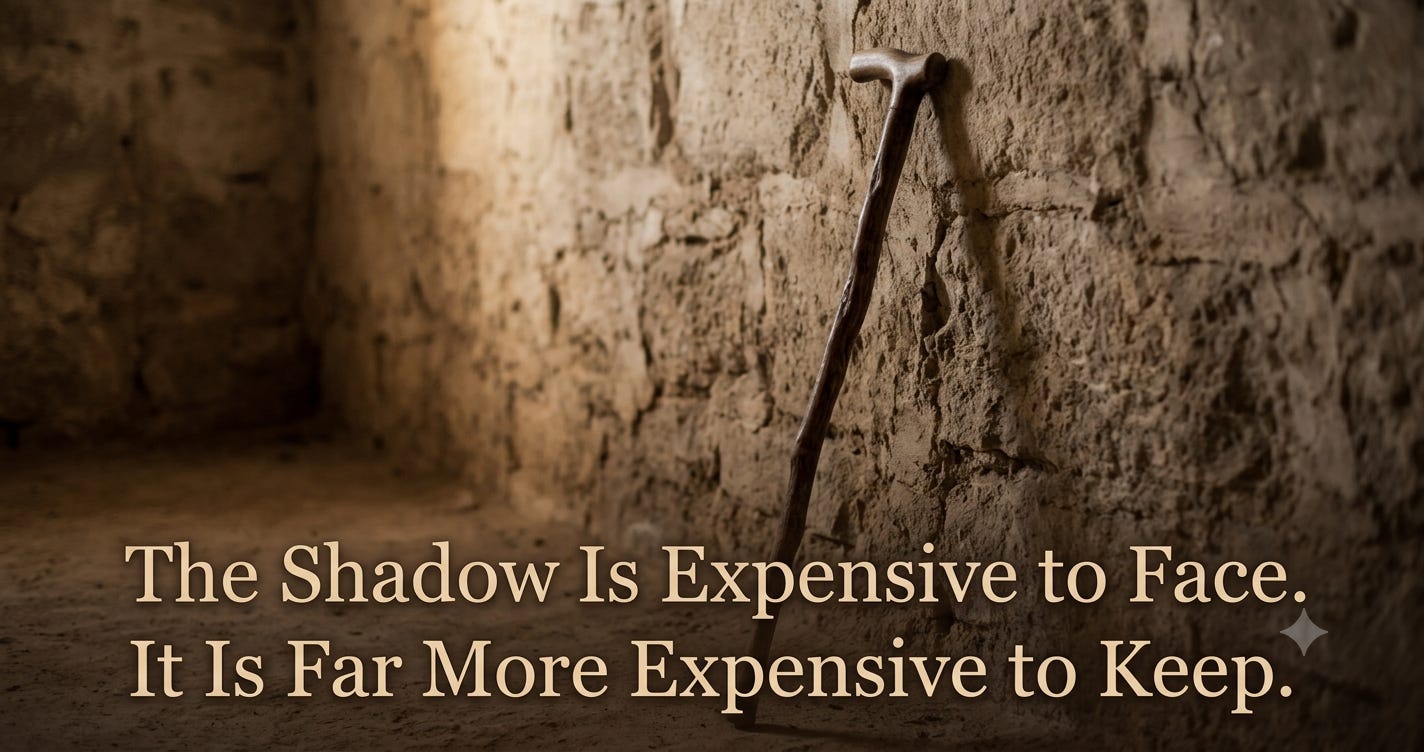
Nobody wants to tell you this part, so I will. Becoming real has a price, and the price is real. You will lose people who only ever loved the version of you that was performing. You will lose rooms you used to be welcome in. You will lose admiration that, when you look at it closely, was never really for you. And here is the other half I have to tell you, because no one told me. The shadow you are tempted to keep, the curated, filtered, presentable version of yourself, has been quietly charging you more, every year, than the price of becoming real would ever total.
That is the math the rest of this article is going to walk through, and I am going to tell you, in the middle of it, what it has cost me, because by now I have a tab.
Where We Are in the Journey
We are in week nine of the shadow arc, within the larger work of The Christian Jung, a systematic theology of psychological wholeness for serious Christians whose orthodoxy is intact but whose inner life still needs healing. For eight episodes we have done the work. We have seen the shadow. We have named its wounds and its buried gold and its parts that refuse to move. Last week we brought it to Jesus and discovered He was already in the room. This week we count the bill.
This is still the shadow. We are not changing the subject. We are asking, finally, what the rest of the work asks. What does it actually cost to integrate the shadow, to stop hiding, and to live as your real, whole, unhidden self. This is Jungian depth psychology read through Scripture, and the claim Scripture has been making the whole time is the claim of this week: there is no becoming real without a death, and there is no resurrection without that death.
Before any of this is psychology, it is Jesus. “Whoever would save his life will lose it, but whoever loses his life for my sake will find it” (Matthew 16:25). And again, in a different image. “Unless a grain of wheat falls into the earth and dies, it remains alone; but if it dies, it bears much fruit” (John 12:24). The math of becoming real is His math. It has always required a dying. We have only ever pretended otherwise.
The Costs Nobody Names
Let me name them in plain language, because the silence around this is part of the problem.
The first cost is the people who only ever met the version of you that was performing. Some of those people will not stay when the performance ends. Not because they are bad. Often because the relationship was never actually with you. It was with the version of you that did not ask anything of them, the one that signaled the right things, the one that fit. When you stop fitting, the relationship is going to be tested. Some will pass that test. Some will not. And the ones that do not are not always the loud ones. Often they just go quiet, and the silence is its own kind of news.
The second cost is rooms. There are rooms you used to be welcome in. Rooms where you had a seat. Sometimes ministry rooms. Sometimes church rooms. Sometimes professional rooms. And when you stop showing up as the curated, religiously-tinted, easy-to-recommend version of yourself, you will not always be invited back. That is real, and it is not something Christian writing usually admits, because the writing is mostly being done from inside those very rooms.
The third cost is admiration. There has been admiration in your life that was attached to the filter. When the filter comes off, the admiration goes with it. And here is the hard truth that took me years to swallow. The admiration was never actually for you. It was for the filter. Losing it is not, in the end, a loss of love. It is the loss of a transaction. And after enough years of paying for admiration with self-erasure, you begin to notice the price.
The fourth cost is grief. You will grieve. You will grieve the years given to the false self. You will grieve the relationships that were only ever held together by the false self. You will grieve who you have had to stop being. Becoming real is not, at the start, a triumphant experience. It is a quieter and sadder experience than most teaching admits, and only later does it open out into something genuinely good.
I want to tell you what becoming real has cost me, and what I have decided is worth it anyway.
I have been doing this work, slowly and not at all in a straight line, for years now. It started, if I had to name the door it walked through, with the moment I recognized the Pharisee spirit in myself. We talked about that one a few weeks ago. Some people call it the religious spirit, and I have come to think of it as the part of me that had been quietly filtering everything, including God, through a particular pair of glasses, what I might call religious-colored glasses. As I worked, over a long stretch, to take those glasses off, something I did not engineer began to happen. My actual self, the one underneath the filter, started coming out.
That was not the goal. I was trying to stop being a Pharisee. The authenticity was a byproduct.
And here is what I learned that nobody warned me about. The actual, unfiltered, embodied version of a Christian is not always impressive to other Christians. Not the kind that talks the way church people talk, and looks the way ministry people look, and signals the right things in the right rooms. I have lost relationships over the change. I have lost respect in the ministry and church world. I have lost opportunities that, on paper, I had earned.
That is a real cost, and I do not want to pretend it has not been one.
Here is what I have decided. The losses are real, and they were exactly what they looked like, but they revealed something I might not have seen any other way. Most of what I lost was admiration for a version of me that was never actually me. It was respect for the filter. The people and the rooms that could only relate to the religious-colored glasses lost interest in me when the glasses came off, and I want to be honest, that has hurt. But the truer thing has hurt less than the filter cost me, every day, for years. The filter was charging me a tax I did not know I was paying.
So I will say it plainly. Becoming real has been the most expensive thing I have done. And keeping the shadow, the filter, was costing me more. I cannot prove that to you. I can only tell you that having paid the price, I would pay it again.
What the Shadow Has Been Charging You
This is the part of the math that is hardest to see, because the cost of keeping the shadow does not arrive as a bill. It arrives as exhaustion. As distance from God you cannot explain. As a faith that is doctrinally correct and emotionally numb. As relationships in which you are loved at arm’s length, because the version of you on offer was always at arm’s length. As an interior that gets quieter and lonelier every year, while the exterior keeps performing.
That is what the shadow has been charging you. You did not know it was a bill, because you were paying it in slow installments of yourself.
Jacob met something of this at the Jabbok. He had been the engineered self his whole life, the schemer, the one who got what he wanted through cleverness, the one whose name even meant heel-grabber. And one night, alone by a river, he wrestled with a stranger until dawn, and when the sun came up he had a new name, Israel, the one who has striven with God, and he had a permanent limp in his thigh (Genesis 32:24-31). Becoming real costs you something. It marks you. Jacob walked away changed. He also walked away limping. The limp was not damage. It was evidence of having stopped being the old man. And it was the part of him no one had ever seen before, which was, finally, real.
What Jung Was Willing to Say
Carl Jung is sometimes quoted as if he treated the shadow as a kind of self-help puzzle, something you solve. He did not. Jung was honest about the cost. He said integrating the shadow takes considerable moral effort, the kind of effort the ego will spend nearly any amount of energy avoiding, because the ego correctly perceives that the work threatens it. He noticed that most people, when they get close enough to the shadow to feel its cost, retreat. They go back to the filter, the comfort, the curated self. Not because they are weak. Because the cost is real, and a person with no reason to believe the loss leads anywhere worth going will not pay it.
That, again, is the edge of Jung. He could tell you the cost is real. He could not, by himself, give you the reason to pay it. The reason to pay it is not psychological. It is theological. The reason is that the One you are becoming real for has already counted what becoming real costs, and named it less than what staying hidden will, and offered Himself as the company you pay it in.
The Door Left Ajar
So this is where the article is asking you to stand. You can see, by now, the cost of becoming real. You can also see, if you are honest, the slower cost the shadow has been charging you the whole time. The math is not going to get clearer than it is right now.
This week inside The Inner Room, I am giving you the method. Three practices for actually paying the price of becoming real on purpose, with company, and with a way of grieving what you grieve without it consuming you. The first I will begin with you here.
Sometime this week, take twenty minutes and a single sheet of paper, and draw two columns. At the top of the first, write: What becoming real has cost me, or might cost me. List honestly: the relationships, the rooms, the admiration, the grief. Do not exaggerate, and do not minimize. Then at the top of the second column, write: What keeping the shadow has been costing me. List honestly there too: the exhaustion, the distance, the loneliness inside the relationships you have, the years. Then read both columns at once. You are not deciding whether to do the work. You are simply, possibly for the first time in your Christian life, seeing both bills in the same place. That single page changes more than you think it will.
That is the first practice. Inside the Inner Room I walk through it fully, then teach the second, a prayer practice for grieving the false self honestly without giving it back a vote, and the third, a written practice for naming the marks, the limps, the visible signs that you have stopped hiding, and learning to read them as evidence rather than as damage.
Pause • Pray • Heal
Pause: Hold both bills in mind, the cost of becoming real and the cost of keeping the shadow. Without arguing with the answer, ask yourself which one you have actually been paying the longest, and which one you have been paying the most.
Pray (John of the Cross, an excerpt from the Prayer of a Soul Taken with Love, Sayings of Light and Love 27):
Mine are the heavens and mine is the earth. Mine are the nations, the just are mine, and mine the sinners. All things are mine, and God Himself is mine and for me, because Christ is mine and all for me. What do you ask, then, and seek, my soul? Yours is all of this, and all is for you. Do not engage yourself in something less, nor pay heed to the crumbs which fall from your Father’s table.
Heal: Where in my life have I been paying for crumbs with my real self, when the Father’s table has been set the whole time?
A Note on Subscribing
If you have been paying the price of becoming real, the lost relationships, the closed rooms, the admiration that turned out to be for the filter, you already know this is not the road most people are walking. To subscribe is to keep walking it in the company of serious Christians who have decided the cost of becoming real is the cheaper of the two prices, and that the limp is part of the evidence. There is a place for you here, exactly as real as you are willing to be.