


Have you ever sat with a dream before and figured out its meaning? Perhaps you used a Biblical dream symbol dictionary and tried to piece it together like a math equation. Or, asked someone who studies the book of Revelation and its symbols a lot. Or perhaps it puzzled you, and you just stopped. Here’s a tip: the first language of dreams isn’t intellect.
God uses signs and symbols as his first language in the Bible. Yes, He spoke in Hebrew (or Aramaic or Greek), but He also spoke in signs and symbols. The reason you don’t understand your dreams is because God wants to develop language with you; language that is built on relationship and understanding your personal calling in the world.
God will use dreams to bypass your intellect because we rely too heavily upon our intellect. So join in on reading this week’s article to unlock signs and symbols as God’s personal language to you.
Where are in this 10-week Dreams Article Arc
We are in week four. For the first two weeks, we established dreams as legitimate conversation with God using both the Bible and Christian history to see that God never stopped using dreams to speak to Christians; Christians just pushed out of their Christian ecosystem with the Enlightenment.
Then last week, we looked at Carl Jung’s dream category called the compensation dream: dreams where we learn more about our soul’s obstacles to our calling. This week:
· if God speaks through dreams, what language does He speak?
· why does God use symbol and image rather than statements or common language?
· what does it mean to learn a language the intellectual mind cannot fully understand?
The Enormous Loss of the Numinous
Because I was raised on the mission field, I have a space in my soul for the mysterious, the unexplained and the numinous. There were things I saw as an MK (Missionary kid) that defied logic. Believing in the supernatural elements of my Christianity was a non-negotiable on the mission field. Things in our current Christian landscape, however, is incredibly intellect-dominate. I am now a PhD Theology student, and I still have to remind myself of the awe and mystery that accompanies our worship of the Father, Son, and Holy Spirit.
We have lost our ability to be ok with the numinous in Christianity. We want answers. Equations. I maintain that this is why so many Christians are fearful about AI: we think our intellect is all we are. But we are not. We are also not just biology. Many people, including many psychologists, think the psyche is biological, and that it connects with the brain and its neurologic output. But neuroscientists are clear that the brain is not where our consciousness is held.
As far as I know, Carl Jung is the only psychologist who recognizes the psyche as something closer to the ‘soul.’ He recognized the psyche as having its own cosmology, its own patterns and ways of making sense of the world. He also was largely uninterested in “abnormal” psychology. He was interested in healthy, psychological behaviors. For many reasons, this made him a unique contributor to science and psychology.
But here is what I want you to understand: Carl Jung said the psyche speaks in symbol, and sign. And that the psyche had a function: he called it a “religious” function. In other words, our psyche speaks the same language as the Biblical prophets, the dreams that are sent to us nightly, and the visions that many saints, mystics and early church fathers received.
When we try to boil our dreams down to our trusty intellect, however, we are often stymied, and for good reason. Over and over for the last few weeks, one Bible phrase has been on repeat in my Spirit: “…lean not on your own understanding…” (Proverbs 3:5). We have become incredibly good at leaning on our own understanding. Dreams confront that.
Another thing that dreams confront is the feeling that the theologian Rudolf Otto called the mysterium tremendum et fascinans, the Holy ‘Other’ as both overwhelming and loving, terrifying and inviting, wholly strange and personally near. Jung borrowed Otto’s term ‘numinosity’ and used it prolifically because our intellect needed to be confronted (see compensating dreams from week 3).
Because we have lost the numinous, and traded it in for the explainable, the apologetics and the clarity of precision, we have lost the mystery of God and His mysterious ways. And yet, night after night, he sends the dream. As if to say, “When you’ve grown tired of intellect, I am here.”
We have largely traded that feeling for clarity. We have traded mystery for explanation. We have traded the image for the proposition. And in doing so, we have gained something -- clarity is not nothing -- but we have lost something the soul requires. We have lost the capacity to encounter God in His full and incomprehensible dimensions, the dimensions Scripture never stops reaching toward even when it cannot contain them.
The dream restores the numinous, the next steps as faith steps, the mysterious ‘other’ and holy God.
The
The Eye at the End of the Dock
I have shared this dream in my podcast before but this dream really stirs the waters of why we need a dream from God.
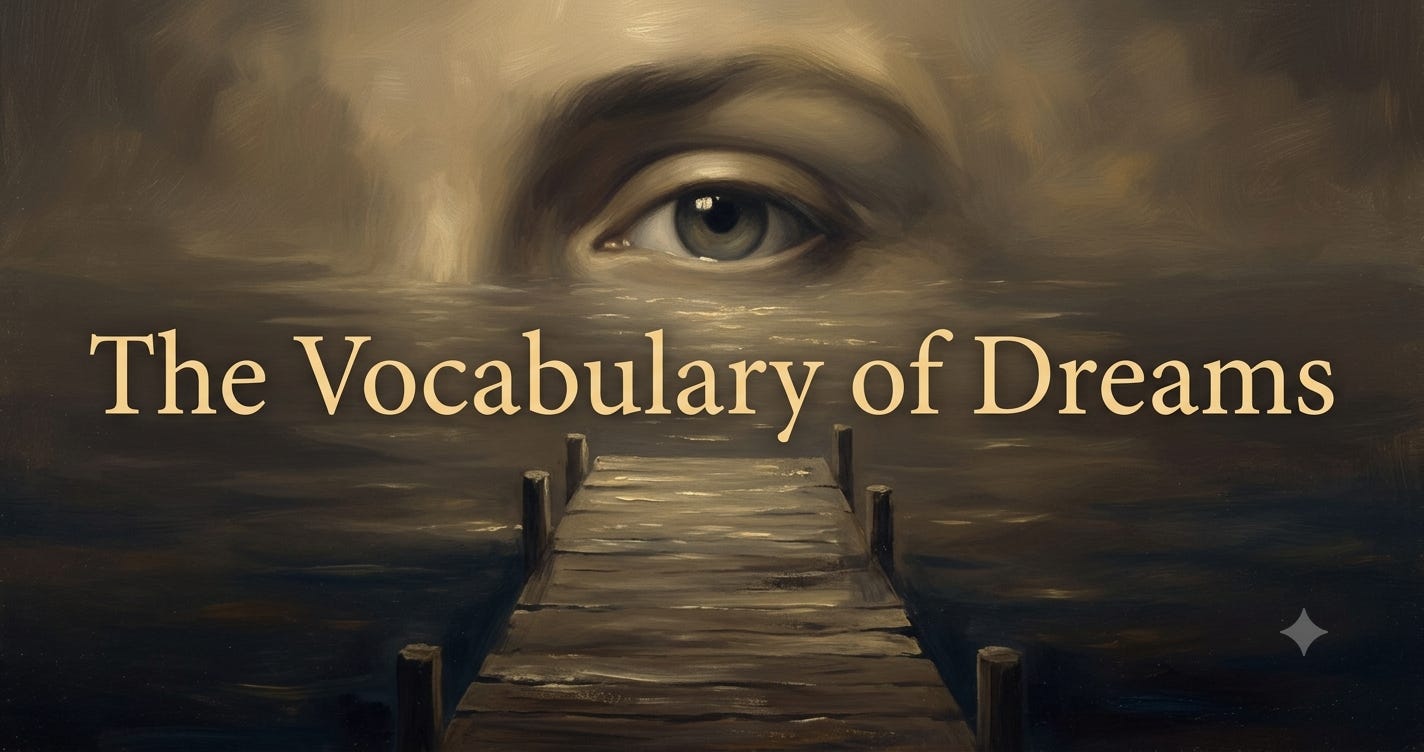
In this dream it is dark, and a moon-light is how I see. I am walking along a simple dock that stretches into a blue, large body of water. I get to the end of the dock and look down. There, the waves ripple of something larger than I can imagine beneath the surface. Then, only an eye begins to emerge. The eye is enormous, bigger than even a whale’s eye. But I am not afraid in the normal sense; I’m afraid in the holy sense. The eye looks at me as if I’m deeply known, loved and cherished. I cannot stop staring. And in the last second before the eye submerges again, I realize I’m looking at ‘The Ancient of Days.’
Most people, when I describe this dream, say the same thing: that sounds like a nightmare.
It was actually one of the most significant spiritual encounters of my life. When I awoke, my room had its customary amber glow from my night lamp, but the air was filled with numinosity. I was buzzing with it. Feeling filled with it. While also feeling fully known, fully seen, fully loved. God, as the Ancient of Days, used a dream and symbols to awaken me to a part of His nature He wanted to reveal to me.
· He didn’t send it through a podcast
· He didn’t send it through the intellect
· He didn’t send it through a “good feeling”
He sent awe through a dream.
Here is what I want you to know: no preacher, podcast, or mental ascent can meet you like a dream can; it can awaken dormant emotional states and use them to help you recognize God in new ways, understand how your ego may be blocking your calling, or help awaken you to unusual pathways that open your calling.
If someone had come to me and said, Angela, God sees you completely and loves everything He sees, I would have received it as true, filed it under what I already believe about God, and moved on with my day. The truth as words, and the Truth as felt, lived reality (in this case, via dreams) are two different ways of knowing God, and one will radically transform you while the other will only tickle your intellect.
That is what symbol does that statement cannot.
Sign Versus Symbol
The distinction Jung draws with sign and symbol is one of the most important in all of depth psychology, and it has direct theological implications. A sign, Jung says, has a fixed, translatable meaning like a math equation. A red light means stop. The word ‘cat’ refers to the animal. The sign can be replaced by what it points to without any loss. Its entire function is to point.
A symbol, however, stands in contrast. It does not have an equitable meaning, and it cannot “stand in” for any noun (person, place, thing). A symbol, Jung said, carries meaning within itself by the emotion it evokes, the message that’s beyond flattening, or a mystery that needs time to unfurl. Often, the symbol will exhaust our attempts to explain it.
The eye in my dream is a symbol. I can tell you that I was looking at the ‘Ancient of Days’, but I would need another ten years to try and relate what the eye meant to me in that moment.
Daniel was in the same boat as me when He first wrote about the Ancient of Days. He does not say words; he uses the visionary experience of Daniel chapter 7 to describe a throne, fire, flames, garments, and a court of ten thousand. Ezekiel, also seeing eyes, did not say, “Well, folks, God is omniscient.” He wrote the symbols of Ezekiel 1 as the wheels within wheels, the eyes, the chariots. When God is described, He is described in symbol, and this is exactly why we need to prioritize our dreams in our Christian walk.
Abiding in Hope, Rather than Decoding in Intellect
I understand the temptation of urgent interpretation, but there are some dreams, like the one I had above, that are clearly a call to simply being immersed in the feeling. Could I try and interpret this dream? Sure, but I would flatten it. I would reduce its awe to an instruction, a prophecy, or even an intellectual exercise.
There is also a temptation to interpret dreams that actually need interpreting. Perhaps the dream is filled with signs, rather than a symbol (like the eye). Take time with even these dreams to let them roll around in your heart and see what emerges. And we will get to interpretation in later weeks, but first, I just want you to sit with a dream, and let its feelings work on you. Don’t lose the most important thing to receive from the gift of a dream.
If you abide with the dream you are activating Hope. Hope, the Bible says, does not disappoint, and you can trust that the work of Hope will be a key to understanding. You can activate hope in your dream abiding by:
· Not expecting explanation for your intellect, but letting your heart and spirit mull it over
· Thinking about the image and what it brings up for you
· Returning to the dream in your imagination and experiencing the feelings again
Psalm 139, “You have searched me and known me, Lord. You know when I sit and when I rise; you perceive my thoughts from afar. Where can I go from your Spirit? Where can I flee from your presence? Such knowledge is too wonderful for me, too lofty for me to attain.”
That phrase (too lofty to attain) is not a failure of theology, however, our culture would tell you it is. It is the right posture toward God that our culture has dismissed: that God isn’t an intellectual response, He is too lofty for that. And He will send the dream to remind you.
The Recalling of the Soul
The contemplative Christian tradition recognizes that knowledge of God can’t be conceptual. Apophatic theology is a theological position that believes God exceeds every human category and that every statement we make about Him is both true and insufficient. This theology holds that the soul does its best work beyond the reach of the intellect and into a place that concepts, words and statements can’t reach. The mystics who held this tradition were not being anti-intellectual. They were naming the limit of the intellect in the presence of the Infinite.
The dream honors that delineation. It does not simply say, “God is the Ancient of Days,” it actually walks you down the pier and makes you look at the eye of it. It makes you feel. It makes you stretch your faith. It makes you see God in areas where you have not previously known him. And you walk away being fully known, fully seen, outside an intellectual code to be cracked.
This week inside the paid tier The Inner Room, we take two Ignatian practices of holding a dream and develop deeper ways of sitting with dreams. One of them is a technique I use personally that has changed the way I receive significant dreams. We also begin to categorize the kinds of images the dream offers, because not all of them call for the same posture.
Pause/Pray/Heal
Pause: Think of a dream that gave you a feeling you could not explain. Not a dream you understood. Let the feeling come back for a moment.
Pray: A prayer of Meister Eckhart:
God, you are more than every image of you I have ever held. You are more than what I can name, more than what I can think, more than what I can receive and still call by its right name. Meet me in the place where the naming stops.
Heal: Tonight, before sleep, write one sentence about a feeling you have been trying to think rather than feel. Name the feeling, not the explanation for it. Let the night bring what the intellect can’t.
If you know someone who has a meaningful dream, pass this to them. Want to learn more about the dreaming life? Join the paid tier of The Christian Jung and lean into the messages God is sending you.
This is interesting to read. I am intrigued by your series, as someone who has suffered with lifelong insomnia and very often nightmares of torment and demonic nature which can only feel like a true spiritual attack on my subconscious. Years on top of years worth. I find myself dreading to go to sleep some nights, simply because being awake is far more pleasant. This is a stumbling block for me some days. “For He gives to His beloved, sleep” comes to mind.
I rarely, if ever, wake up feeling truly rested, but rather relieved to be back in reality. Something I haven’t ever talked openly about!
Of course! Will pray for you tonight 🙏