

Where We Are in the Journey
We are walking, week by week, into what I am calling The Inner Exodus—a slow unfolding toward a systematic theology of psychological wholeness. This is not a departure from doctrine, nor is it an attempt to replace theology with psychology. Rather, it is an honest reckoning with a persistent gap: Scripture reveals ontological truth about God with clarity and authority, yet the human person does not automatically live in alignment with that truth. Something in us receives, filters, distorts, resists, or embodies what has been revealed, and that “something” must be taken seriously if transformation is to occur.
That “something” is the psyche—the place where theology becomes lived experience, where belief becomes perception, and where truth either takes root or becomes subtly displaced. If we do not descend into the inner life—into what Scripture calls the deep waters of the heart (Proverbs 20:5)—we risk building a Christianity that is externally precise but internally fragmented. Contemplative Christianity has always insisted on this descent, not as an optional layer of spirituality, but as the very place where God meets the human person in truth, forming wisdom in the secret place within (Psalm 51:6). Today, we begin that descent together, not as an abstract exercise, but as a lived encounter with the depths where God is already at work.
There Are Rooms Beneath Your Awareness
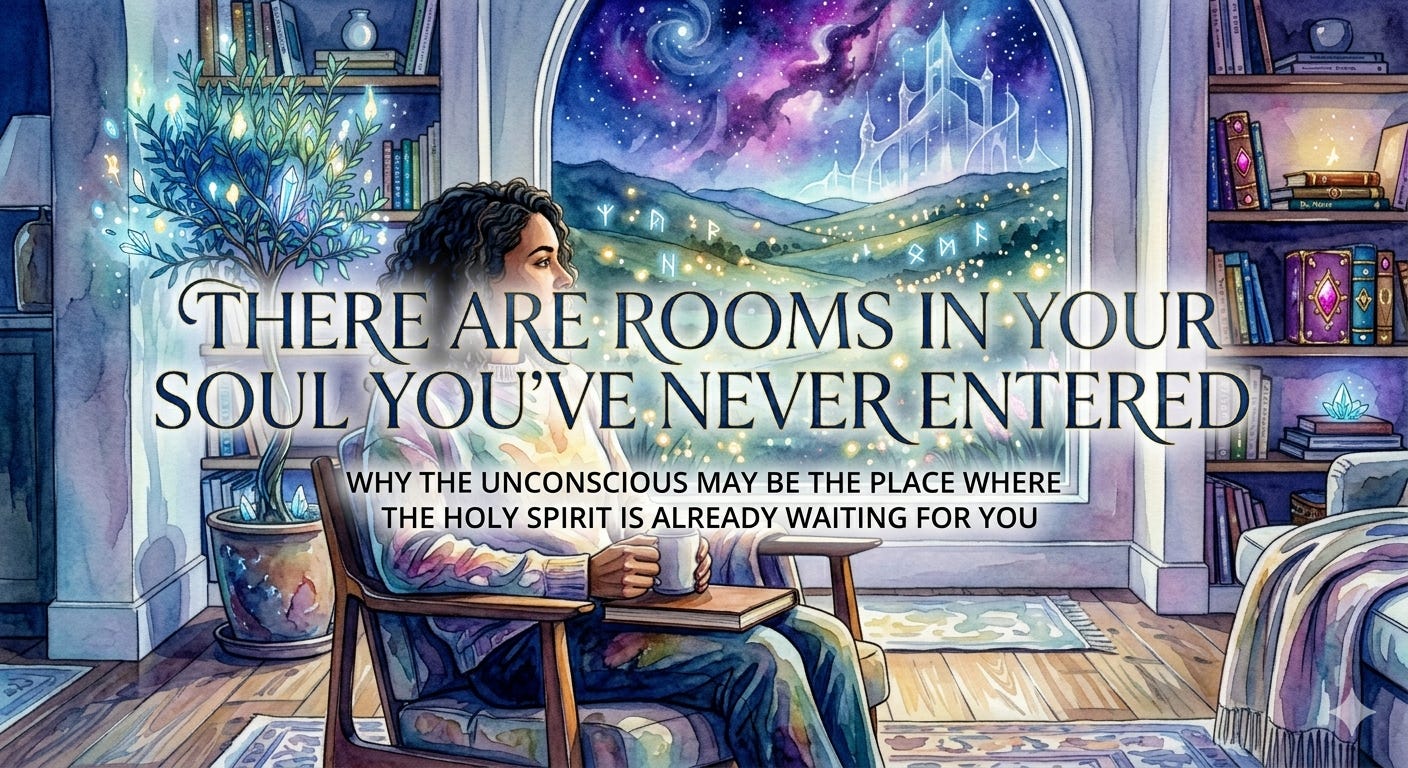
There are places in your soul you have never walked, rooms you have never entered, and conversations with God you have never had—not because He has been silent, but because something in you has not yet learned how to listen at that depth. Carl Jung named this hidden territory the unconscious, not as an enemy of faith, but as a vast interior landscape where memory, symbol, fear, desire, and meaning are continually forming beneath conscious awareness. For Jung, this was not merely psychological data; it was the terrain in which the deepest movements of the soul take shape.
Scripture has always pointed to this same reality, though in different language. The biblical writers speak of the deep waters within the human heart (Proverbs 20:5), of truth formed in the innermost being (Psalm 51:6), and of eternity itself set within us (Ecclesiastes 3:11). These are not surface-level descriptions; they are invitations into a depth most of us rarely explore. We tend to live in the bright, ordered rooms of the conscious mind, where thoughts are clear and language is precise, yet beneath that surface are layers that continue to shape our experience whether we acknowledge them or not.
Forgotten memories,
inherited beliefs,
unprocessed wounds,
and even dormant callings all reside there, quietly influencing how we perceive God, ourselves, and the world around us.
Why Scripture Feels Alive (Even When You Don’t Know Why)
There is a reason Scripture often feels alive in a way that exceeds intellectual understanding. When Joseph dreams of stars bowing before him (Genesis 37:9), when Peter receives a vision that redefines the boundaries of the Gospel (Acts 10:9–16), or when John records the symbolic imagery of Revelation (Revelation 1:12–16), we are not witnessing moments of logical deduction. We are encountering a mode of divine communication that moves through image, symbol, and encounter—forms that speak directly to the deeper structures of the psyche rather than to the analytical mind alone.
Jung observed that the psyche does not primarily speak in propositions; it speaks in images that carry layered meaning. This insight helps us understand why biblical narratives resonate so personally across time and culture. David and Goliath is not merely a historical account (1 Samuel 17); it is a pattern that mirrors the inner experience of facing overwhelming fear. Ruth’s loyalty is not only a story of devotion (Ruth 1:16–17); it touches something in us that recognizes the cost and beauty of steadfast love. These stories endure because they are not only true—they are archetypal, engaging both the personal and collective layers of the human soul. Scripture does not merely inform us; it awakens something that was already present within us, calling it into conscious relationship with God.
The Unconscious Is Not Empty—It Is Structured
Jung’s understanding of the unconscious was not that it is chaotic or random, but that it is deeply structured. He distinguished between the personal unconscious, which holds our individual experiences, memories, and unrealized potentials, and the collective unconscious, which contains shared human patterns—archetypes such as the Hero, the Prophet, the Servant, and the Mother. These patterns appear across time and place, suggesting they are woven into the very fabric of human experience.
Scripture engages both of these layers simultaneously, speaking into the personal story of each individual while also activating something universal and ancient. This is why theology, while essential, cannot fully account for the lived experience of faith. Theology defines what is true about God, but the psyche determines how that truth is perceived, internalized, and enacted. Without attending to the psyche, we may affirm correct doctrine while unknowingly living out distorted images of God shaped by fear, trauma, or unconscious belief. The work of descending into the unconscious is therefore not a departure from faith, but a necessary step in allowing truth to become fully embodied.
A Dream That Reveals Everything
Jung once recorded a dream of a dark industrial city, where the buildings were blackened, the streets were soaked with rain, and the atmosphere felt heavy with despair. Yet at the center of this city, there was an open square filled with light, and within that light stood a single magnolia tree in full bloom—radiant, white, and alive in stark contrast to the surrounding darkness. The image struck him with such force that it remained with him long after he awoke, carrying a meaning that was both psychological and deeply symbolic.
He came to understand the city as representing the conscious world, burdened by complexity, suffering, and fragmentation, while the tree symbolized the living center of the psyche—the place of wholeness that remains untouched by external darkness. From a Christian perspective, we recognize this center as Christ Himself, the One in whom all things hold together (Colossians 1:17) and through whom life is continually renewed. Even when the visible structures of our lives feel disordered or heavy, there remains within us a center that is alive, because Christ came that we may have life abundantly (John 10:10). The task is not to create that center, but to discover it.
Where Christianity Quietly Went Wrong
One of the quiet tragedies within modern Christianity is the tendency to elevate intellectual understanding at the expense of lived encounter. We are rightly taught to love God with our minds (Matthew 22:37), yet when the experiential work of the Holy Spirit is diminished, the intellect often takes its place as a substitute. The result is a form of faith that is structurally sound but spiritually inert, capable of articulating truth without embodying it. This dynamic echoes the tension Jesus identified in the Pharisees, whose knowledge of the law did not translate into transformed hearts (Matthew 23:27–28).
Jung’s clinical observations offer a surprising point of convergence with this concern. Over the course of his work, he noted that many individuals who engaged deeply with their inner life did not abandon their faith but returned to it with greater depth and maturity. Their journey into the psyche did not lead them away from Christianity; it led them into a more integrated and experiential form of it. This suggests that the path inward, when rightly oriented, does not compete with faith but can serve as a means through which faith becomes more fully realized.
The Unconscious as Holy Ground
If we are willing to reconsider our assumptions, the unconscious can be understood not merely as a psychological construct but as a kind of inner sanctuary. Just as the Holy of Holies was hidden behind a veil, accessible only through intentional approach (Hebrews 9:3–7), so too much of our inner life remains veiled from conscious awareness. Within that sacred space were objects rich with symbolic meaning—the manna that sustained life (Exodus 16:33), the rod that blossomed (Numbers 17:8), and the law that defined covenant relationship (Exodus 25:16). Each of these pointed beyond itself to a deeper reality fulfilled in Christ.
In a similar way, the unconscious communicates through symbols that carry meaning beyond literal explanation. These symbols are not arbitrary; they are the language through which deeper truths are mediated to the soul. When we learn to attend to this language, we are not abandoning theological clarity but allowing it to take root in a more profound way. The psyche becomes a place where truth is not only known but encountered, where doctrine moves from abstraction into lived reality.
Dreams, Symbols, and the Voice Beneath the Surface
Scripture repeatedly affirms that God speaks through dreams, visions, and symbolic encounters, bypassing the ordinary processes of conscious reasoning. From Jacob’s ladder (Genesis 28:12) to Joseph’s interpretations (Genesis 41:25), from Daniel’s visions (Daniel 7:1–14) to the warnings given to the Magi in dreams (Matthew 2:12), these moments reveal a mode of communication that engages the deeper layers of the human person. Dreams function as a bridge between the conscious and unconscious, carrying images that reflect both personal experience and spiritual movement.
These images often appear simple—a house, a river, a door—yet they carry meanings that unfold over time. They may reveal areas of wounding, invitations to growth, or movements of the Spirit that have not yet reached conscious articulation. To dismiss them as random is to overlook a significant dimension of how the psyche processes reality and how God may choose to engage that process. The unconscious is not beyond God’s reach; rather, it may be one of the primary places where His preparatory work is already unfolding.
Listening Without Controlling
The movement into the depths requires a posture that is unfamiliar to many of us, because it involves relinquishing control. To descend into the inner life is to risk encountering what has been hidden, to face aspects of ourselves we may have avoided, and to surrender the illusion that we are fully self-aware. Yet this descent is not a movement into chaos but into encounter, a willingness to trust that God is present even in what we do not yet understand.
To pay attention to your inner life is not an act of self-absorption but of reverence. It is an acknowledgment that God’s work in you may extend beyond what you can immediately articulate. When you notice your dreams, your emotional reactions, or the symbols that arise in your imagination, you are standing at the threshold of the inner sanctuary. The question is not how to control or decode these experiences perfectly, but how to remain present to them with openness and prayerful attention.
The Question That Changes Everything
What is the state of your inner city? When you look honestly, do you find areas that feel dark, crowded, or weary, shaped by pressures you cannot fully explain? And yet, is there also a sense—however faint—that somewhere within you there remains a center that is alive, a place untouched by the fragmentation you experience on the surface? This question is not meant to produce immediate answers but to invite awareness of what is already present.
Your task this week is not to fix or resolve anything but simply to notice. Pay attention to your dreams, to the Scriptures that seem to speak directly into your circumstances, and to the emotions that arise without clear cause. Write them down, sit with them, and bring them before God in prayer. The goal is not analysis but attentiveness, a willingness to recognize that the Spirit may already be speaking in ways you have not yet learned to hear.
Pause • Pray • Heal
Pause
Take a few moments to sit quietly before God, allowing your body to settle and your thoughts to slow. Ask gently what may be stirring beneath the surface, and remain present without forcing an answer.
Pray (St. Catherine of Siena)
Eternal God,
You are a deep sea, into which the deeper I enter,
the more I find, and the more I find,
the more I seek.
O abyss, O eternal Godhead,
O sea profound,
what more could You give me than Yourself?
Heal
Where in your life do you sense an invitation not to fix or control, but simply to go deeper, trusting that God is already present there?
If something in you feels stirred—subtle but persistent—that is not accidental. This is the work we are entering together: a slow, careful descent into the inner life, where faith becomes not only something we profess, but something that takes root in the depths of who we are.
In my opinion, this writing boarders on the edge of enlightenment. As if a butterfly is emerging from its chrysalis. How better than to build a framework to support the "starting point" of this journey. I give credit to all the personal "work" which the author has given across the years of turmoil, trials and tests. From those many turmoils, trials and tests now steps forward a person much more refined. Dare I even say, more Christ like?
Yet in all this glory, has the desired "goal" been reached? Likely not, for the veil still is drawn. Yet the veil has been pierced by many before us. Thus, we walk in faith that maybe, just maybe our turn to see behind the veil will soon occur. Take comfort in knowing that we are NOT the first to desire to live beyond the veil.
In my attempt to find Oneness with Jesus I will drop a bread crumb. This crumb is the first paragraph of the introduction to the book "Not of This World, A Treasury of Christian Mysticism, James S. Cutsinger, World Wisdom, Inc 2003."
"My kingdom is not of this world (John 18:36). Guided by these words of their Master, Christian mystics have never been at home in this world. Far from being escapists, however, the best of them have always kept a firm hold in the important word ‘this’. God’s kingdom is certainly not of ‘this’ world -the fallen world of corruption, competition, and death. But beneath the surface of ‘this’, the gospel teaches that there is also a ‘that:’” a world “so loved” (John 3:16) by God that He has entered it fully in order to make it one with Himself. The true mystic confirms this teaching, assuring us that we can partake of that oneness even in the midst of our present life. Somewhere on the other side of what seems – right in front of us, if we would only look – there exists something more: an “Other World that ‘now’ is”, infused with Diving presence and power, and shimmering through our most cherished moments of beauty and love.”
So grateful for the restack!!