


I built a health plan at the start of this year that I am genuinely proud of. I kept it faithfully for twelve weeks. And then I abandoned it in the space of about eighteen hours, and I have not been able to get back to it since. For a long time I called that a failure. I was wrong about what it was, and this article is what I learned instead.
I am going to tell you the whole of that story before we are done. But to tell it honestly, I have to start somewhere else, with a part of you that you already know about, because you have been fighting it for years.
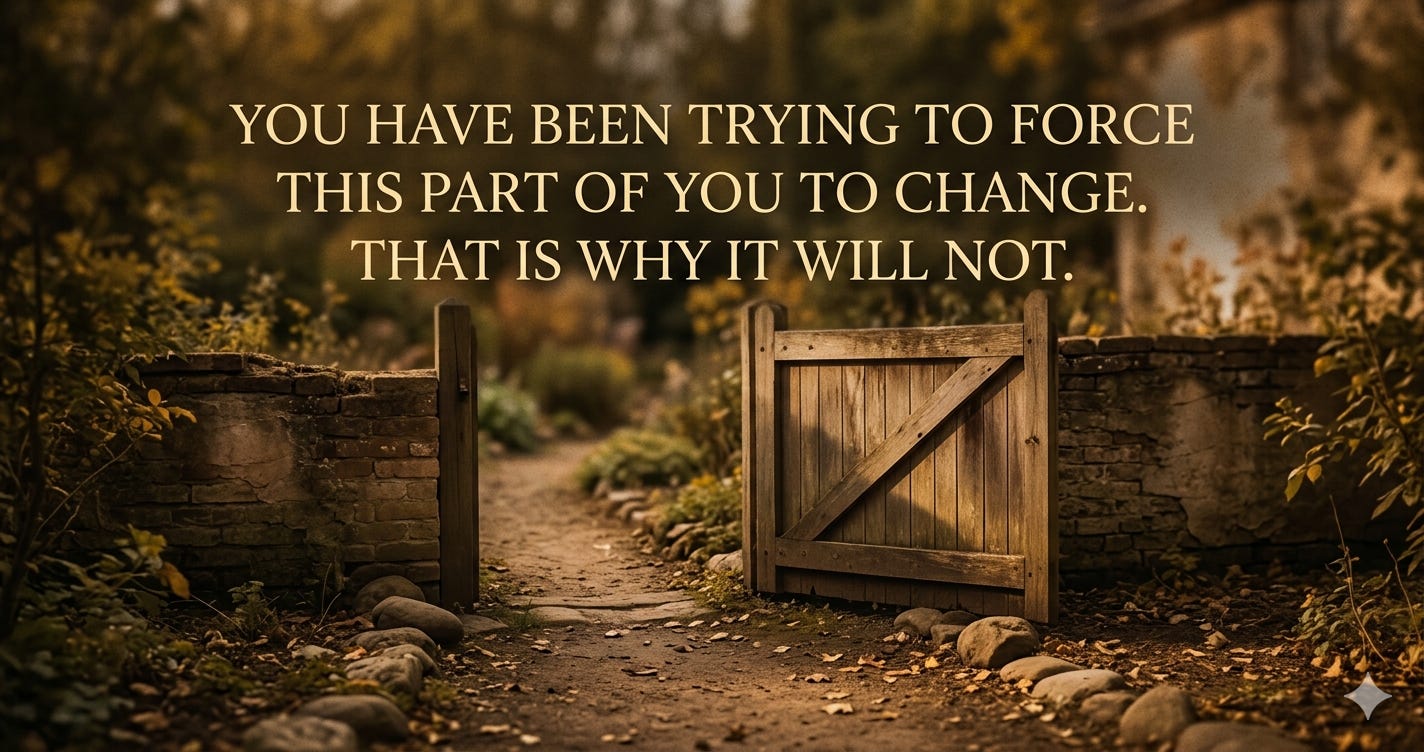
There is something in you that will not change. You know exactly the one I mean. You have prayed about it. You have repented of it. You have made the plan, downloaded the app, found the accountability partner, read the book. And that part of you is still, today, standing precisely where it has always stood. I want to tell you why it will not move. And I want to tell you that the reason is not the one you have been given, and that the reason is not weakness.
Where We Are in the Journey
We are in week seven of the shadow arc, within the larger work of The Christian Jung, a systematic theology of psychological wholeness for serious Christians whose orthodoxy is intact but whose inner life still needs healing. We have learned to see the shadow, the wounds it hides and the gold it hides. This week we stay with the shadow and go further in, to the parts of it that have seen everything we have learned so far, and still will not move.
This is Jungian depth psychology read through Scripture, and I want to be precise about the claim. The shadow is not a passive pile of material waiting for you to sort it. Parts of it are active. Parts of it resist. And those resisting parts are not your enemy, even though they have cost you a great deal. They are doing a job. They were assigned that job a long time ago, and no one ever told them the job was finished.
The Part That Will Not Move Is Doing a Job
Here is the reframe the whole episode turns on. A part of you that refuses to change is not lazy and it is not disobedient. It is afraid, and it is working.
Every resisting part of you was hired during a hard season. Somewhere back there, something happened, or kept happening, and a part of you stepped forward and took on a protective job. It learned to numb, or to control, or to keep you small, or to not hope, or to eat when the feeling came, or to never fully rest, because in that season, that behavior genuinely kept something safe. The part was not foolish. It was, at the time, correct. It protected you, and it has never been told it can stop.
That is why force does not work on it. When you attack a resisting part with willpower, with shame, with rebuke, you are not addressing a lazy thing. You are ordering a frightened and loyal guard to abandon its post. And the guard cannot tell the difference between you and the original danger. From inside the part, your willpower is just one more threat to brace against. So it digs in. Every Christian who has ever tried to shame a stubborn part of themselves into changing, and watched it get worse, has met this exact mechanism.
Scripture Has Always Known This
We did not invent the divided self. Paul described it with a precision no psychology textbook has improved on. “For I do not do the good I want, but the evil I do not want is what I keep on doing” (Romans 7:19). Read that slowly. That is a man of enormous spiritual maturity describing a part of himself that will not obey him. And notice what Paul does not do. He does not say, try harder. He does not say, you simply lack discipline. He comes to the end of his own willpower and he cries out, “Wretched man that I am! Who will deliver me from this body of death?” (Romans 7:24). The answer, the very next line, is not a technique. It is a person. It is Christ.
And look at how Christ Himself approaches a stuck person. In John 5 there is a man who has been an invalid for thirty-eight years, lying by a pool he believes can heal him. Jesus comes to him, and Jesus asks him what is, on the surface, an absurd question. “Do you want to be healed?” (John 5:6). Of course he wants to be healed. He has been lying there for thirty-eight years. Except Jesus does not ask absurd questions. Jesus asks it because after thirty-eight years a person has built an entire life around the condition, and some part of even the most desperate person is not sure who it would be without the very thing it longs to be free of. Jesus engages the will. He does not override it. He heals with the person, not against them.
And there is Israel in the wilderness, freshly delivered, free, and already aching to go back. “Would that we had died by the hand of the Lord in the land of Egypt, when we sat by the meat pots and ate bread to the full” (Exodus 16:3). They are remembering the food of their slavery and missing it. That is the resisting part exactly. It is loyal to the old bondage, not because bondage was good, but because bondage was known, and the part would rather have a familiar misery than an unfamiliar freedom.
I want to tell you something that is still happening to me. It is vulnerable, and it is also, I think, deeply relatable.
At the start of 2026, my husband and I both knew it was time to make a serious change in our health, and we decided to give it a full year. Because we know ourselves, we did not just announce a goal. We built a plan that accounted for our actual weaknesses. We know we reach for dessert when dinner is too early. We know we choose badly when we are tired. We know that with no plan in place, we will not choose well at all. And the plan had to work for both of us, because my husband is a type 1 diabetic, and my own health needs require a great deal of protein. I spent weeks getting us ready for day one.
Then day one came, and we were off. The weekly weigh-ins were genuinely exciting. Every week gave us data, and the data let us tune the plan. By week twelve the numbers had moved into double digits, and we were proud of ourselves. It was working.
And then I received a letter. I am not going to tell you what was in it. But it was devastating, and in the space of one envelope, every hope I had built for 2026 crashed and burned.
I stayed on the plan, after that letter, for about eighteen hours.
That was ten weeks ago. In the ten weeks since, I have not gained the weight back, but I have not lost any either. I have only maintained. And here is the part I most want you to see, because it is the whole of this episode. The plan is not gone. My husband and I still sit down at the kitchen table every Monday to plan our meals and do the grocery shopping. The system is completely intact. It is right there in front of me. And week after week, with the system sitting right there, I have made choices that do not serve me.
For ten weeks I have called that a failure of willpower. Laziness. A part of me that simply will not do what I have told it to do. But this episode is making me reconsider, and I want to reconsider it out loud, with you. What if the part of me that put up the blockade is not lazy at all. What if, after a hope that big crashed that hard, some part of me is simply afraid to hope again, and a blockade is the only way it knows to keep me from being devastated a second time.
I am still inside this one. I do not have the resolution for you. But I have stopped believing that the part of me that will not move is my enemy.
What Jung Understood About the Shadow’s Refusal
Carl Jung spent his working life with the part of people that will not move, and he was clear-eyed about two things.
The first is that the shadow cannot be willed away. It is not reached by good intentions or by argument. Jung wrote that confronting it takes real and honest effort, the kind most people would rather not spend, because it is far easier to keep the resisting part out of sight than to turn around and actually face it.
The second is the one that should change how you pray. Jung observed that a shadow that is condemned and suppressed does not vanish. It goes underground, and underground it grows stronger, and more autonomous, and it begins to run the person’s life from behind, unseen. The thing you refuse to face does not leave. It just stops asking your permission. Which means the war you have been waging on the stuck part of yourself, the war of shame and suppression and force, has not been failing by accident. It has been making the part stronger. You have been feeding the thing you were trying to starve.
The Door Left Ajar
So if force does not work, what does. You do not defeat a resisting part of the shadow. You learn its name, you learn its fear, and you reassure it, slowly, that the danger it is still guarding against is over.
This week inside The Inner Room, I am giving you the method. Three practices for working with a resisting part instead of against it. The first practice I will begin with you here.
The next time you approach the thing you have been unable to change, the food, the phone, the avoided conversation, the abandoned plan, do not start with the behavior. Start with your body, and do one thing: notice the resistance without overriding it. Notice the brace. The heaviness that arrives. The small interior flinch. Most of us have spent years trying to bulldoze straight through that flinch. This week, just once, stop at it. Put a hand where you feel it, and say, inwardly and without contempt, I know you are there, and I know you are afraid, and I am not going to force you. You are not giving up. You are doing the opposite of giving up. You are finally addressing the part that actually controls the behavior, instead of the behavior it controls.
That is the first practice. Inside the Inner Room I walk through it fully, then teach the second, praying Romans 7 and the question from the pool as a person with a divided will, and the third, a written practice of interviewing the resisting part, on paper, to find the fear it has been guarding all along. If you have been at war with a part of yourself for years, this is where the war ends and the actual healing begins.
Pause • Pray • Heal
Pause: Bring to mind the part of you that will not change. Instead of resolving once more to defeat it, ask it a single question, and wait without arguing: what are you afraid would happen if you stopped.
Pray (Teresa of Avila, “Nada te turbe,” found written in her breviary):
Let nothing disturb you, Let nothing frighten you, All things are passing away: God never changes. Patience obtains all things. Whoever has God lacks nothing; God alone suffices.
Heal: Where in my life have I mistaken a frightened, loyal part of myself for an enemy, and what would it look like to be patient with it instead?
A Note on Subscribing
If you came to this article tired of forcing yourself, and you are still reading, that is not a small thing. It is the beginning of a gentler and more honest way to change. To subscribe is to keep walking it alongside people who have stopped believing the war on themselves was ever going to work. This is sanctuary, not subscription management, and there is a place for you here, at exactly the pace you are actually moving.