

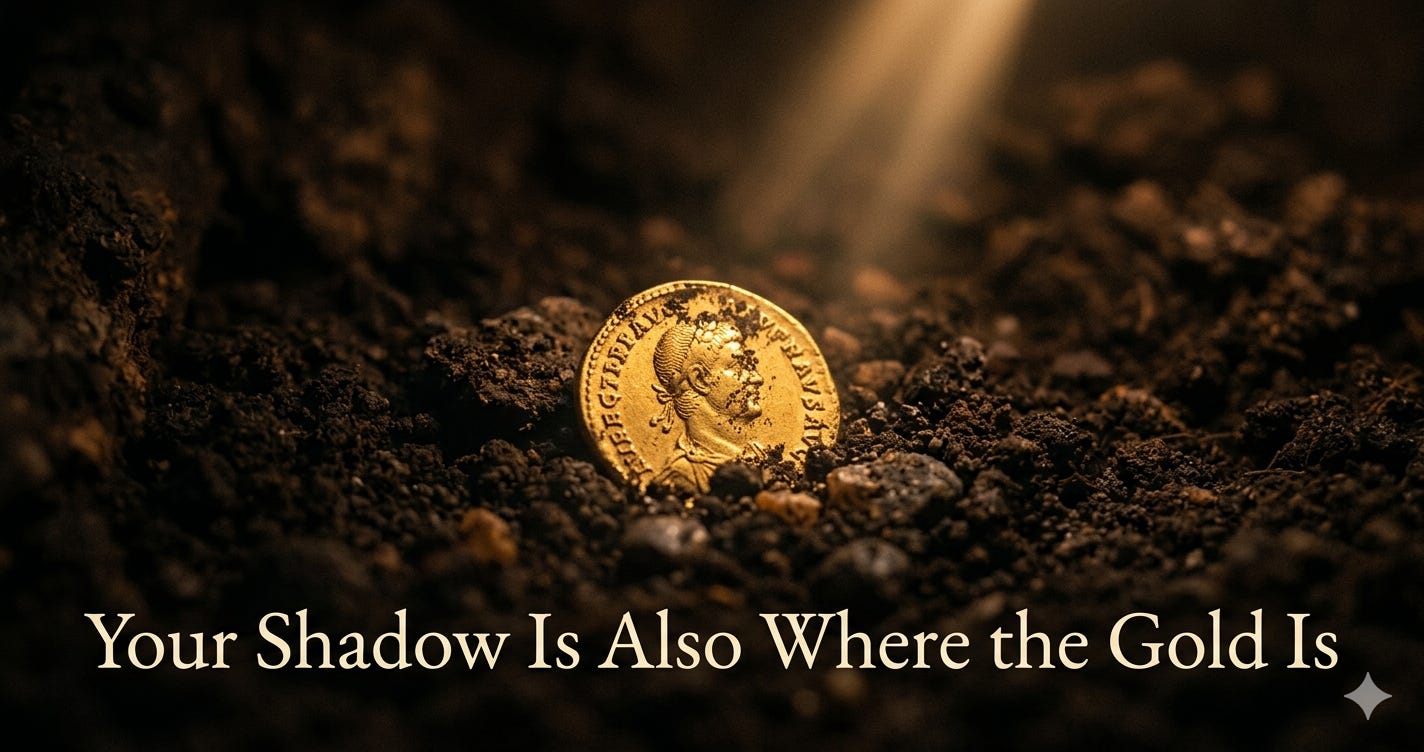
For five weeks now we have talked about the shadow as though it were a basement. The dark room where you put what you are ashamed of. That is true. It is also only half the map. Nobody warns you about the other half. The shadow is also where you buried the gold.
I need to be careful with that word gold, because I can already feel the orthodox reflex tightening. Claiming your gifts sounds like pride. Humility, we were taught, means thinking less of yourself, making yourself small, never making too much of what you can do. And “becoming who you were made to be” can sound like secular self-help wearing a thin Christian coat. So before we go a step further, let me put a parable between us and that worry.
A man gives three servants money to steward. Two of them invest what they were given and bring back more. The third is afraid, and so he digs a hole and buries his portion in the ground, and when the master returns the servant hands it back exactly as he received it, unused, unrisked, unspent (Matthew 25:24-30). We tend to read that servant as lazy. Look again. He is not lazy. He is careful. He is modest. He did not lose anything, he did not gamble, he kept his head down. And the master is not pleased. The master calls the burial what it actually was, and the servant himself had already named it: “I was afraid” (Matthew 25:25).
Burying a gift is not humility. Scripture is willing to say so plainly. Now we can talk about the gold.
Where We Are in the Journey
We are in week six of the shadow arc, within the larger work of The Christian Jung, a systematic theology of psychological wholeness for serious Christians whose orthodoxy is intact but whose inner life still needs healing. We have named what lives below the surface, traced how patterns persist, learned to listen to the soul in image and dream, and looked directly at the mask and the fear of being seen.
This week the arc turns over. Everything before now has examined what the shadow hides that we are ashamed of. The Jungian depth-psychology term for this week is the golden shadow, and it names something most of us were never told. The same darkness that holds the wounds also holds the gold. The gifts you buried. The aliveness you were told to put away. The part of you that was simply, embarrassingly, too much for some room you were standing in. This is still shadow work. It is just shadow work in the direction of recovery.
How the Gold Gets Buried
A gift does not usually get buried because someone hated it. It gets buried because of love, or the need for love. It gets buried to belong.
A child lights up about something. She is loud about it, or strange about it, or simply more interested in it than the people around her are comfortable with. And she learns, fast, the way children learn everything, that this particular brightness costs her something. It draws the wrong kind of attention. It does not fit the room. So she does the intelligent thing. She files the gift away. She gets smaller in that one specific spot. And because she is a person of faith, she may even baptize the burial and call it humility. He calls it dying to self. She calls it not wanting to be prideful. And the gift goes into the ground, and the years go over it, and she forgets the hole is even there.
That is the golden shadow. Not a sin. A treasure, kept in the dark, by a frightened and well-meaning steward.
I want to tell you about a gift I buried, and then dug back up.
When I was a child, I took Scripture more seriously than almost anything else in my life. I read it. I memorized it. And then, because I have never been able to leave a true thing sitting unused, I implemented it. I was the implement-queen. If the Bible said it, I wanted to do it.
When I was about thirteen, I was reading the fourteenth chapter of First Corinthians, and it confused me. Paul was writing about prophecy as though it were an ordinary thing. Something that might happen in your own living room. A way of loving and encouraging the people right around you. And then he said it plainly, that we should eagerly desire to prophesy (1 Corinthians 14:1). So, being who I was, I went and found my pastor, and I asked him how. How do I actually do this. He looked down at me, he patted me on the head, and he said, “Aren’t you cute.” And he walked away.
He did not mean it as a wound. But it landed as one. Something in me filed that moment away, and the lesson it taught was simple. The part of Scripture I was most drawn to was not a serious part. It was a cute part. A child’s part. Something I would grow out of.
Years later I was sitting in a theology conference at a seminary, and the presenter said, from the front of the room, that theologians had dissected the entire Bible, word by word, and found meaning everywhere in it. Everywhere except the Song of Songs. Who knows, he said, what is going on with that weird little book. And the room laughed.
I did not laugh. Because in that moment I understood something about myself, and it was not comfortable. I have never come to Scripture the way that room came to it. I do not approach the Bible first as an academic exercise, a careful dissection of Hebrew and Greek. I come to it and I am pulled, every single time, straight to the parts that room was laughing at. The supernatural. The miraculous. The dreams and the visions that everyone finds embarrassing. The weird little book nobody can explain. I read Scripture in symbols, because symbol is the language I have always believed God actually speaks.
For a long time I treated that pull as the thing to hide. The unserious thing. The thing that would keep me out of the rooms I wanted to be respected in. So I buried it, and I worked at fitting in.
Here is what I know now. That buried instinct was never the childish thing. It was the gift. It is the exact instinct that lets me do the work I do now, braiding Jungian psychology and theology together, taking symbols and dreams and the strange supernatural seams of Scripture seriously instead of laughing them off. The thing I buried in order to fit in was the thing I was made to do. My shadow was not only holding my wounds. It was holding my gold.
What Jung Saw, and What Scripture Saw First
Carl Jung is the one who gave us the phrase. He noticed, working with people for decades, that the shadow was not only a container for what we are ashamed of. It also held what he called positive potential. Gifts. Vitality. Whole capacities a person had pushed out of awareness because, somewhere back there, the gift had not been safe to own.
And Jung noticed something else, something genuinely useful for this week. He noticed projection. He noticed that the surest place to find your own buried gold is to look hard at the people you most admire. Not casually like. Admire. The person whose ease in front of a room makes something ache in you. The person whose creativity you find yourself slightly envious of. Jung’s claim, and it is worth testing against your own life, is that intense admiration is very often a gift of your own, handed out to someone else for safekeeping because you did not believe you were allowed to carry it.
Scripture saw the mechanism long before Jung named it. Look at how God calls people. He goes to Gideon, who is hiding in a winepress, threshing wheat in secret because he is afraid, and the first thing the angel of the Lord says is “The Lord is with you, O mighty man of valor” (Judges 6:12). Mighty man of valor. To the man in the winepress. And Gideon’s answer is essentially, you have the wrong man, “my clan is the weakest in Manasseh, and I am the least in my father’s house” (Judges 6:15). God names the gold first. Gideon can only see the hole he buried it in. That gap, between what God names and what we can see, is the whole drama of the golden shadow.
Catherine of Siena, the fourteenth-century mystic and reformer, wrote to one of her followers a line that has outlived seven hundred years: “If you are what you should be, you will set all of Italy ablaze” (Letter T368). Notice what she did not write. She did not write if you are more than you are. She wrote if you are what you should be. The fire was never in becoming someone larger than God made you. The fire is in stopping the burial.
The Door Left Ajar
You may be able to feel, already, the shape of the hole in your own yard. A gift you set down. A brightness you dimmed on purpose. A thing you are good at that you still cannot quite say out loud that you are good at. Noticing the hole is not the same as digging.
This week inside The Inner Room, I am giving you the method. Three practices for the slow, careful work of recovering the gold without it curdling into ego. The first practice is a practice of attention, and I will begin it with you here.
For the next several days, keep a single note somewhere close, on your phone, in a notebook, and title it: Where I came alive. And simply catch the moments. Not the moments you performed well. The moments something in you lifted. A conversation that made you lose track of time. A task most people find tedious that you found quietly thrilling. A subject you cannot stop reading about. Do not analyze any of it yet. Just collect. Your body has been keeping the address of your buried gift the whole time, and aliveness is the street it lives on. After a week, the list will start to point somewhere.
That is the first practice. Inside the Inner Room I walk through it fully, then teach the second, a prayer practice of reclaiming the gold you have projected onto the people you admire, and the third, the written inventory of what you buried, when, and what you were told the day you buried it. If you have a gift in the ground, this is where you pick up the shovel.
Pause • Pray • Heal
Pause: Bring to mind one person you genuinely admire, the kind of admiration that has a small ache in it. Ask, without rushing the answer, whether what you admire in them is a gift of your own that you handed away for safekeeping.
Pray (Catherine of Siena, Prayer to the Holy Spirit):
Holy Spirit, come into my heart; draw it to Thee by Thy power, O my God, and grant me charity with filial fear. Preserve me, O ineffable Love, from every evil thought; warm me, inflame me with Thy dear love, and every pain will seem light to me. My Father, my sweet Lord, help me in all my actions. Jesus, love, Jesus, love. Amen.
Heal: What did I bury, and what was I told, or what did I fear, on the day I buried it?
A Note on Subscribing
If something in you recognized itself in this article, a gift set down, a brightness you dimmed, a part of you that went quiet years ago, then you already know this work is not optional. To subscribe is to keep walking it alongside a community of serious Christians who believe that becoming whole, gold and all, is part of what Christ died to restore in us. This is sanctuary, not subscription management. Come in.