
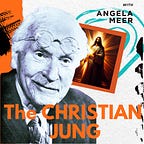

Why does Scripture call God a consuming fire, and what if that fire is an invitation rather than a threat? In this fourth episode of the Foundations series on The Christian Jung, Angela Meer introduces nepsis, the watchfulness of the Desert Fathers and Mothers, as the first building block of contemplative prayer.
Angela begins with a mural she walked past every day as a child on the mission field: a great fire above the words “Our God is a consuming fire.” She reflects on how fear of God shapes our bodies and our theology, and why we so often intellectualize our faith so we don’t have to face that fear.
From there she turns to the watchmen on the walls, Habakkuk on the ramparts, and Moses turning aside to see why the bush was not burning up, and to a dinner table in Zürich, where a young Albert Einstein first started Carl Jung thinking about “a possible relativity of time as well as space.”
The episode offers four simple questions for practicing nepsis in everyday life, a word on discernment, and John of the Cross’s image of a log that blackens before it becomes fire. It closes with a short guided moment of watchfulness and a traditional prayer of the church: “Come, Holy Spirit, fill the hearts of your faithful, and kindle in them the fire of your love.”
God’s consuming fire doesn’t leave ashes. It makes you burn.
Closing block (paste at the end of the description):
📖 Read the full article and guided practice: [FREE ARTICLE LINK]
🌿 Join the wait list for A Return to Awe, my fall course: https://landing.mailerlite.com/webforms/landing/f6n3e2
🕯️ Join the FireHouse Contemplative Communities wait list: https://landing.mailerlite.com/webforms/landing/d5f3x9
Angela Meer is an ordained minister with graduate degrees in Jungian studies.
It’s time to awaken holy wonder.
Show notes:
Scripture referenced (World English Bible): Hebrews 12:28-29; 1 Peter 5:8; 1 Thessalonians 5:6; Habakkuk 2:1; Exodus 3:2-4; Luke 24:32.
Key terms: Nepsis (watchfulness, sobriety, vigilance; a building block of early Christian contemplative practice). Synchronicity (Jung’s term for meaningful coincidence between inner and outer events). The dark night (John of the Cross’s name for God’s purifying work in the soul).
Sources: C. G. Jung to Carl Seelig, February 25, 1953 (Letters, vol. 2). John of the Cross, The Dark Night of the Soul, Book II, ch. 10.
Prayer: “Come, Holy Spirit,” a traditional prayer of the church.
Episode tags: Foundations, Carl Jung, contemplative prayer, Contemplative Series, burning bush, Habakkuk, watchfulness


