

A few years ago I found myself returning again and again to a strange place in Scripture. It wasn’t Romans, the Gospels, or the theological passages I had studied carefully for years. Instead, I kept opening the Song of Solomon, a book I had rarely spent serious time with before.
At first I couldn’t explain why it kept pulling me back. The poetry felt mysterious, but it drew me in, in the way it spoke so openly about longing and desire. Yet the voice of the Shulamite woman carried an emotional honesty that I could not ignore. When she cried out, “Let him kiss me with the kisses of his mouth” (Song of Solomon 1:2), the language of intimacy felt far removed from the polished spiritual life I had learned to present to the world.
Slowly a realization began to form. The faith I had practiced outwardly — the one that could explain theology, quote Scripture, and speak confidently about spiritual maturity — was not the same kind of faith described in this ancient love poetry. I had learned how to perform faith, but I was only beginning to learn how to love God with the vulnerable honesty that real intimacy requires.
That discovery exposed something deeper in me. Without realizing it, I had built an identity that functioned well in church and ministry but quietly hid parts of my soul. Carl Jung described this phenomenon with a simple but powerful word: the persona.
Where We Are in the Journey
If you have been walking with me through these essays, you know we are exploring what I call The Inner Exodus — the systematic theology of psychological wholeness I am developing here. This project is an attempt to bring two streams of insight into meaningful conversation: the theological vision of transformation found throughout Scripture and Christian tradition, and the psychological insights about the human soul articulated by Carl Jung.
Christian theology has always spoken about transformation — about dying to the old self and being renewed in Christ (Romans 12:2; Colossians 3:9–10). Jungian psychology, in a different language, describes a parallel process in which the human personality moves toward integration and wholeness. What interests me is what happens when these two lenses illuminate each other.
So far in this journey we have begun tracing several patterns:
• The Holy Spirit does not simply improve the false self — He dismantles it.
• The biblical story of Exodus mirrors the inner journey where God leads the soul out of bondage into freedom.
• Psychological insight can help us recognize the inner structures that either resist or cooperate with this transformation.
• Today we examine one of the most important of those structures: the persona.
The Mask We Learn to Wear
Scripture is filled with stories in which spiritual transformation begins when a carefully constructed identity finally cracks. Moses offers one of the clearest examples. Raised in Pharaoh’s palace, he lived outwardly as an Egyptian prince while secretly belonging to a Hebrew people enslaved by that empire. His life functioned through a fragile identity that allowed him to survive within power while hiding a deeper truth about himself.
Eventually that tension shattered. Through violence, exile, and forty years in the wilderness, Moses lost the identity he believed defined him. Only after that unraveling did he encounter God at the burning bush and hear the calling that would shape his true life (Exodus 3:1–6). What looked like the collapse of his identity became the doorway through which God revealed his purpose.
Other biblical figures walk through similar moments of unmasking. Esther lived safely within the persona of a Persian queen until the crisis of her people forced her to reveal her hidden identity before the king (Esther 4:16). Peter confidently proclaimed loyalty to Jesus but discovered the fragility of that persona when fear led him to deny Christ beside the fire (Luke 22:54–62). In each story the breaking of the mask was not destruction but transformation.
These stories remind us of a difficult truth: the identities that protect us in one season can imprison us in another. What once helped us survive may eventually prevent us from becoming who God created us to be.
When the Role Becomes the Self
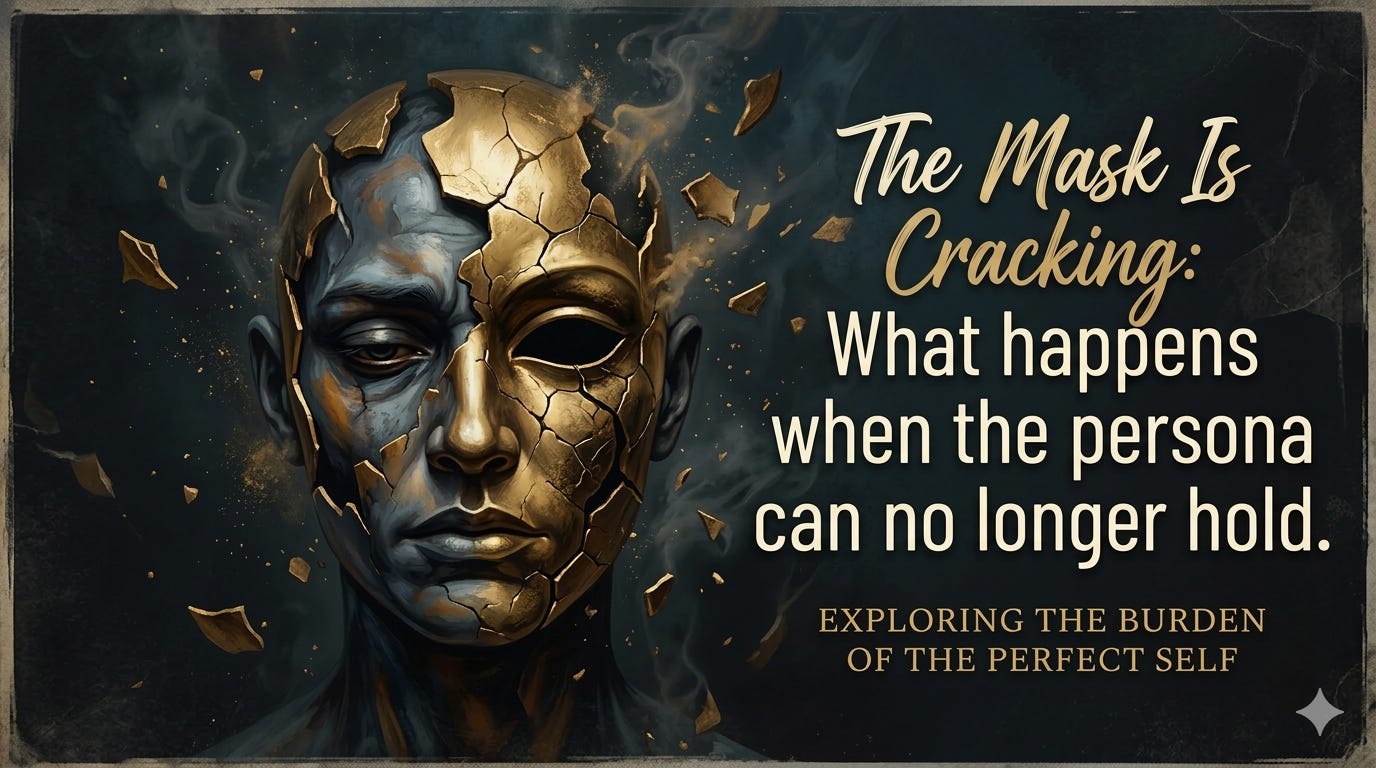
Carl Jung used the word persona to describe the psychological mask people wear in order to navigate the expectations of society. The term originally referred to the theatrical masks worn by actors in ancient drama, where a single performer might portray several characters depending on which mask he held before his face. Jung believed something very similar happens in the development of ordinary human identity.
From childhood we learn which behaviors are welcomed and which invite rejection. Gradually we shape ourselves in ways that allow us to belong within family, culture, and church. Over time this adaptation becomes the identity we present to the world. The persona allows us to function effectively in roles such as teacher, pastor, parent, or leader.
The danger, however, is not wearing the mask.
The danger is forgetting that we are wearing one.
Jung warned that people often become completely identified with the persona — the professor with his lectures, the minister with his sermons, the believer with an image of righteousness. At that point the mask no longer serves the soul; it begins controlling it. The person forgets that the role was originally meant to be a tool rather than an identity.
Scripture describes a similar danger when Jesus confronts the religious leaders of His day. “Everything they do is done for people to see… On the outside you appear righteous, but on the inside you are full of hypocrisy and lawlessness” (Matthew 23:5, 28). The problem was not religious devotion but the substitution of performance for inner transformation.
Paul describes the Christian life in language that echoes the removal of this mask: “And we all, with unveiled faces, beholding the glory of the Lord, are being transformed into His image” (2 Corinthians 3:18). The image of the unveiled face suggests a soul that gradually becomes transparent before God rather than hidden behind carefully managed identities.
The Moment I Realized I Was Performing Faith
The confrontation with the persona in my own life unfolded slowly rather than dramatically. As I continued reading the Song of Solomon, I began noticing how differently the Shulamite woman approached her beloved compared with the way I approached Christ. Her words were direct and emotionally honest, filled with longing and vulnerability that bypassed the polished language I had learned to use in prayer.
Gradually I realized how much of my spiritual life had been organized around maintaining an image of strength. I could teach Scripture and articulate theology clearly, yet I rarely allowed my weakness, confusion, or longing to appear before God. The persona of the capable Christian had become so natural that I rarely questioned it.
The poetry of the Song disrupted that pattern. Instead of presenting strength first, it invited vulnerability. Instead of protecting an image, it opened space for desire, longing, and relational honesty. Slowly I began speaking to Jesus differently, bringing parts of my life into His presence that I had once hidden behind competence and certainty.
In that process Paul’s words began to resonate in an entirely new way: “My grace is sufficient for you, for My power is made perfect in weakness” (2 Corinthians 12:9). What once sounded like a theological statement began to feel like a spiritual invitation. The grace of God was not asking me to perfect the mask; it was asking me to remove it.
What Happens When the Mask Falls
In the Inner Room this week we will explore what happens when the persona begins to loosen its grip on our spiritual lives. This stage can feel disorienting, because the identities that once helped us function begin to feel unstable. Yet this moment often marks the beginning of genuine transformation.
Inside the Inner Room we will explore:
• how the persona forms within childhood and religious environments
• why the confrontation with the shadow often follows the collapse of the mask
• the contemplative practices that allow the soul to descend safely into deeper truth.
The Inner Room
For those who are new here, the Inner Room is the paid subscriber portion of this Substack. The free essays explore the ideas behind the Inner Exodus, but the Inner Room moves deeper into formation — the spiritual practices and reflections that help these insights become lived experience.
Many readers discover that once they begin recognizing the persona in their lives, curiosity and uncertainty arise together. The Inner Room is designed as a quieter place to explore that process with intention, where psychological insight and Christian spiritual practice can meet in a slower rhythm.
Pause • Pray • Heal
Pause
Take several minutes to sit quietly before God. Notice whether any roles or identities surfaced in your mind while reading this reflection. Ask the Spirit to reveal whether those identities help you live truthfully before Him or whether they sometimes function as masks.
Pray
A prayer from St. John of the Cross:
“O guiding night!
O night more lovely than the dawn,
O night that has united the Lover with His beloved,
transforming the beloved in her Lover.”
Heal
Where might the Holy Spirit be gently loosening the identity you once needed to survive so that the deeper self God created can begin to emerge?
I really appreciated this piece. The way you connected Jung’s idea of the persona with the spiritual cost of performing faith felt especially sharp. That contrast between outward maturity and vulnerable intimacy with God was so well drawn.
How lovely to find your writing. Jung and Christianity? Of course!